
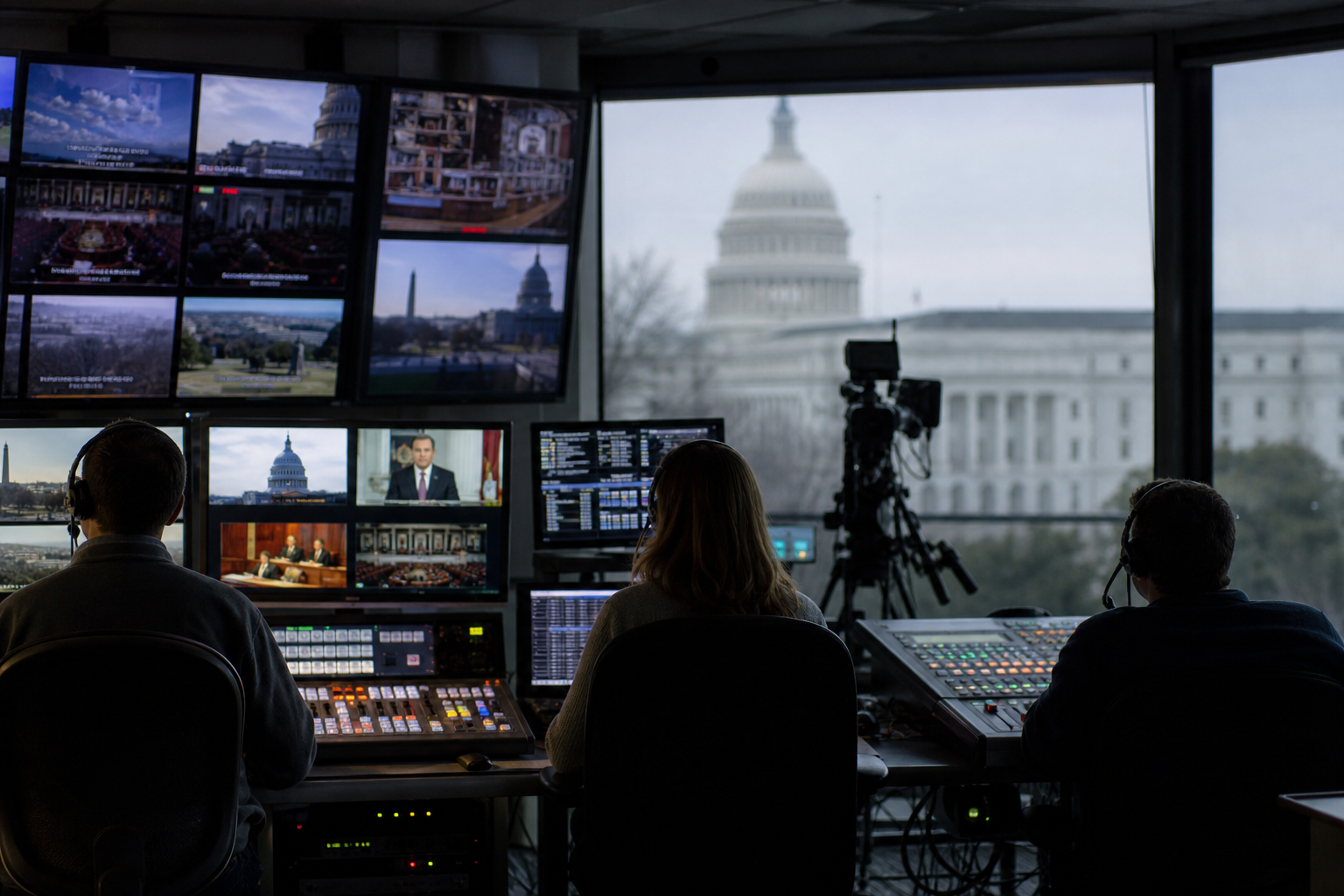
FCC Chairman Brendan Carr’s calls for stricter accountability in broadcast licensing have reopened an old American argument: what, exactly, do broadcasters owe the public in exchange for access to the public airwaves?
That debate is worth having carefully. It touches two principles conservatives should take seriously at the same time: first, that the government should not become an arbiter of political opinion; second, that licenses granted by the public are not private property in the ordinary sense and do carry legal obligations.
The Distinction Between Broadcast and Other Media
One reason this discussion often becomes confused is that Americans now consume news through a mix of platforms that operate under very different legal rules. Over-the-air television and radio stations use spectrum licensed by the federal government. Cable networks, streaming services, podcasts, and websites generally do not operate under that same broadcast licensing framework.
That distinction matters. The Federal Communications Commission has long regulated broadcasters on the theory that spectrum is limited and that its use must serve the public interest, convenience, and necessity. That phrase has been part of communications law for decades, even if its practical meaning has often been contested.
So when Carr talks about accountability, he is not inventing a new federal role out of whole cloth. The FCC already has authority over broadcast license renewals, ownership rules, technical compliance, indecency standards in limited contexts, and other matters tied to use of the airwaves. The real question is how far that authority should extend when complaints involve alleged news distortion, political bias, or editorial misconduct.
Bias Is Real, but Regulation Is a Blunt Instrument
Conservatives are not wrong to notice ideological imbalance in major media institutions. For many years, legacy news organizations have often reflected the assumptions of highly educated, urban, culturally progressive professional classes. That does not mean every report is false or every journalist acts in bad faith. It does mean that selection bias, framing bias, and cultural uniformity can shape coverage in ways that are both powerful and difficult to detect from inside the newsroom.
Still, it does not follow that the federal government should police ordinary political slant. That would be a serious mistake. A broadcast license should not become a leash by which whichever party controls Washington pressures stations into more favorable coverage. If Republicans establish that precedent, Democrats will use it. And once that cycle begins, the public interest standard risks becoming a partisan weapon.
That is the core institutional concern. Rules created for today’s frustrations rarely stay confined to today’s targets.
What Accountability Can Legitimately Mean
There is, however, a narrower and more defensible case for broadcast accountability. If a licensee is accused of deliberate factual falsification, fraudulent representation to regulators, or serious violation of its statutory and technical obligations, the FCC can ask questions. A license is a public trust, not an entitlement. Basic oversight is not censorship.
That is especially true where the issue is not viewpoint but process: whether broadcasters met disclosure requirements, whether ownership structures comply with federal rules, whether emergency alert obligations are being honored, whether representations made to the commission are accurate, and whether there is evidence of intentional deception rather than mere editorial judgment.
Those are proper regulatory questions because they involve objective duties. The line should remain bright between enforcing law and punishing opinion.
The Public Interest Standard Needs Restraint
The phrase public interest has always had a certain vagueness to it, and vagueness in regulation invites abuse. One administration can read it narrowly and focus on technical stewardship. Another can read it expansively and treat it as a license to supervise newsroom behavior. For those who care about constitutional norms, that should be unsettling regardless of which side benefits in the short term.
Conservatives, in particular, have good reason to be wary of broad discretionary power in the hands of administrative agencies. The same skepticism that applies to environmental, labor, or education bureaucracy should apply here as well. A regulator with too much interpretive room can drift from enforcing rules to shaping culture.
That does not mean the FCC must be passive. It means the commission should proceed with precision and humility. If there is misconduct, identify it clearly. If there is a rule violation, cite the rule. If there is evidence of intentional distortion in a matter relevant to licensing, explain the standard being applied and apply it consistently. What should be rejected is the temptation to use administrative process as a proxy battle over ideological frustration with the national press.
Why This Matters Beyond One Chairman
The larger issue is not Brendan Carr himself but the precedent any chairman leaves behind. American institutions work best when they are strong enough to do their proper job and restrained enough not to do someone else’s. The FCC’s job is not to guarantee balanced political outcomes in media. Nor is it to ignore misconduct simply because journalism occupies a privileged place in public life.
Media organizations, for their part, should not pretend that any scrutiny is automatically an assault on press freedom. Trust in the press has fallen sharply over many years, and not simply because politicians complain about coverage. News organizations have made their own contribution to that decline through visible double standards, a blending of reporting and activism, and an often reflexive hostility toward dissent from elite opinion. If broadcasters want the public to defend their institutional independence, they should take institutional credibility more seriously.
That means clearer corrections, firmer separations between news and opinion, greater transparency about editorial decisions, and more internal viewpoint diversity than many legacy outlets currently tolerate. Those reforms would do more to address concerns about bias than any ambitious federal theory ever could.
A Conservative View of the Proper Balance
A prudent conservative position should reject two equal and opposite errors:
- Error one: assuming that because media bias exists, regulators should aggressively supervise political content.
- Error two: assuming that because press freedom is vital, broadcast licensees should face no meaningful scrutiny at all.
The better course is constitutional sobriety. Enforce the law where the law clearly applies. Demand honesty from license holders. Protect the distinction between verifiable misconduct and protected editorial judgment. And resist the desire to turn every institutional disappointment into a reason for federal intervention.
That approach may be less emotionally satisfying than promises to “do something” about media bias. But self-government depends on more than righteous indignation. It depends on preserving rules that can survive a change in party control.
Broadcast regulation was never meant to become a national referee for political narratives. Yet neither was it meant to be an empty formality. If Carr’s push leads to a more serious conversation about those boundaries, that could be healthy. If it becomes a back door for politicized content regulation, it will have done more harm than good.
In a country already too eager to settle cultural arguments through administrative power, that distinction matters.
