
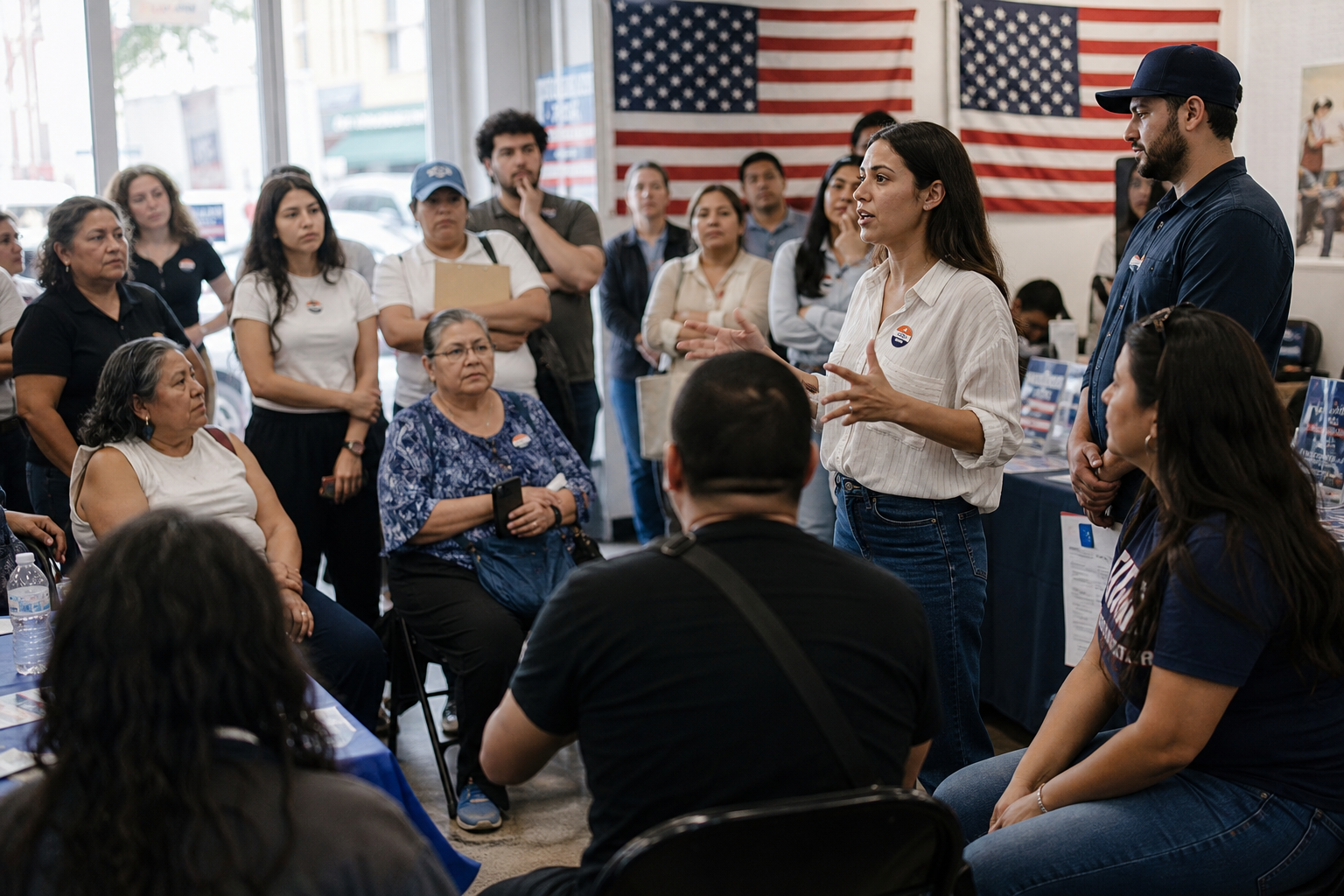
American politics has a habit of turning every election result into a permanent verdict. One cycle tells us a party has built a new majority; the next tells us that same coalition has collapsed for good. The truth is usually less dramatic. Voter coalitions shift, but they do not move all at once, and they rarely move for a single reason.
That is worth keeping in mind as Democrats wrestle with signs of slippage among two groups they have counted on heavily in recent years: younger voters and Hispanic voters. Republicans have made real gains with parts of both constituencies, especially among working-class Hispanics and younger men frustrated by inflation, housing costs, and a politics that often seems more performative than practical. Still, it would be a mistake to assume those voters are now permanently Republican. It would be an equal mistake for Democrats to assume they can win them back without changing anything.
The Democratic Problem Is More Than Messaging
Democrats often explain losses among younger and Hispanic voters as a communications problem. Their argument is familiar: the party's agenda is broadly popular, but it has failed to explain itself clearly. There is some truth in that. Modern politics is saturated with fragmented media, weak local institutions, and national messaging that often misses how people actually live. But messaging is only part of the problem.
For many voters, especially those outside affluent professional circles, politics is judged less by rhetoric than by conditions. Can they afford rent? Can they buy a house? Are groceries still rising faster than paychecks? Do schools function? Does the border appear orderly? Is public safety improving or deteriorating?
On those practical questions, Democrats have faced a harder test. Younger voters have come of age amid high housing costs, student debt burdens, and a labor market that can be strong in headline numbers while still feeling precarious in daily life. Hispanic voters, far from being a monolithic bloc, often include churchgoing, entrepreneurial, family-centered communities that do not naturally fit a progressive cultural template. Many are open to government help in limited areas, but they are often skeptical of bureaucratic drift, permissive disorder, and ideological politics.
Why Young Voters Are Not as Secure for Democrats as They Once Looked
Younger voters still tend to lean Democratic overall, particularly on issues like climate change, abortion rights, and health care. But that broad advantage can conceal important weaknesses. The youngest adults are not simply looking for expansive promises from Washington. Many are looking for competence, affordability, and social stability.
That creates a vulnerability for Democrats when the party appears more animated by elite cultural disputes than by cost-of-living concerns. A politics that spends too much time policing language, signaling moral purity, or indulging activist causes can lose its appeal when ordinary voters are trying to build careers and households. The young are often idealistic, but they are also practical. They notice when government promises outrun government performance.
Republicans should be careful here. If the GOP assumes every disaffected young voter has embraced small-government conservatism, it will overread the moment. Many younger voters are not becoming doctrinaire conservatives. They are becoming suspicious of institutions that seem ineffective, expensive, or detached from everyday concerns. That suspicion cuts in multiple directions.
Still, Democrats ignore it at their peril. A party that wants durable support from younger Americans must offer more than generational symbolism. It must show that it can govern in ways that make adulthood more attainable.
Hispanic Voters Are Not an Ideological Abstraction
The Democratic Party's difficulties with Hispanic voters are, in some ways, even more revealing. For years, too much political commentary treated Hispanic Americans as if they were a fixed ideological category rather than a varied and upward-looking electorate. That was always a poor reading of the country.
Hispanic voters differ by region, national origin, class, religion, and generation. Cuban Americans in Florida do not vote exactly like Mexican Americans in Texas, nor do either vote exactly like Puerto Ricans in the Northeast. But one common thread has become increasingly clear: many resent being spoken to as members of a political constituency first and citizens second.
That matters because progressive politics often tends to frame voters through categories of grievance and representation. Yet many Hispanic voters are animated by more traditional concerns: wages, family, public order, patriotism, education, and religious liberty. Some are receptive to conservative arguments on entrepreneurship, parental authority, and the value of assimilation into a common civic culture.
This does not mean Republicans have solved the puzzle. It means Democrats can no longer assume demographic change automatically favors them. The old idea that population trends alone would deliver a lasting center-left majority was always too mechanical. Voters are people, not census projections.
Why These Voters May Still Return
Even so, there are reasons Democrats may recover some of this ground. First, party identity in the United States is sticky. Many voters who flirt with the other side in one cycle revert in the next, especially if they dislike the opposing party's nominee, tone, or governing priorities.
Second, younger voters remain more left-leaning than older voters on several major social and environmental issues. If Democrats can combine that ideological advantage with a more credible economic message, they may stabilize their standing.
Third, Hispanic voters are not uniformly conservative on economics or immigration. While many favor border enforcement and lawful order, that does not necessarily translate into support for every Republican proposal. Voters can be culturally moderate or conservative while still favoring a significant government role in health care, education, or tax credits for families.
And finally, Republicans themselves can squander opportunity. If the GOP comes across as inattentive to urban costs, indifferent to legal immigration, or rhetorically reckless on questions of race and identity, Democrats will have a ready opening to reclaim wavering voters.
The Real Choice Before Democrats
The deeper question is whether Democrats interpret these warning signs seriously. They can continue to believe that any erosion among young and Hispanic voters is temporary and mostly the product of messaging failures. Or they can consider the more uncomfortable possibility that parts of the party have moved too far toward a professional-class progressivism that is culturally narrow and politically brittle.
That shift has consequences. It can make the party sound more fluent in activist vocabularies than in the moral language of work, family, order, and citizenship. It can encourage policies that are expansive in aspiration but thin in administrative competence. And it can leave ordinary voters with the impression that elite priorities are crowding out common ones.
From a conservative perspective, this moment presents both an opportunity and a caution. The opportunity is obvious: a Republican Party that speaks clearly about affordable energy, school quality, public safety, family formation, and economic mobility can compete where it once struggled. The caution is that these gains will not hold if the party treats them as automatic or substitutes resentment for governing seriousness.
In the end, young and Hispanic voters are not rewards to be claimed by demographic destiny or campaign cleverness. They are citizens making judgments about which party seems more capable of preserving order, expanding opportunity, and respecting the country's social fabric. Democrats may yet win many of them back. But if they do, it will not be because history guaranteed it. It will be because they adjusted to the country as it is, rather than the coalition they assumed would last forever.
