
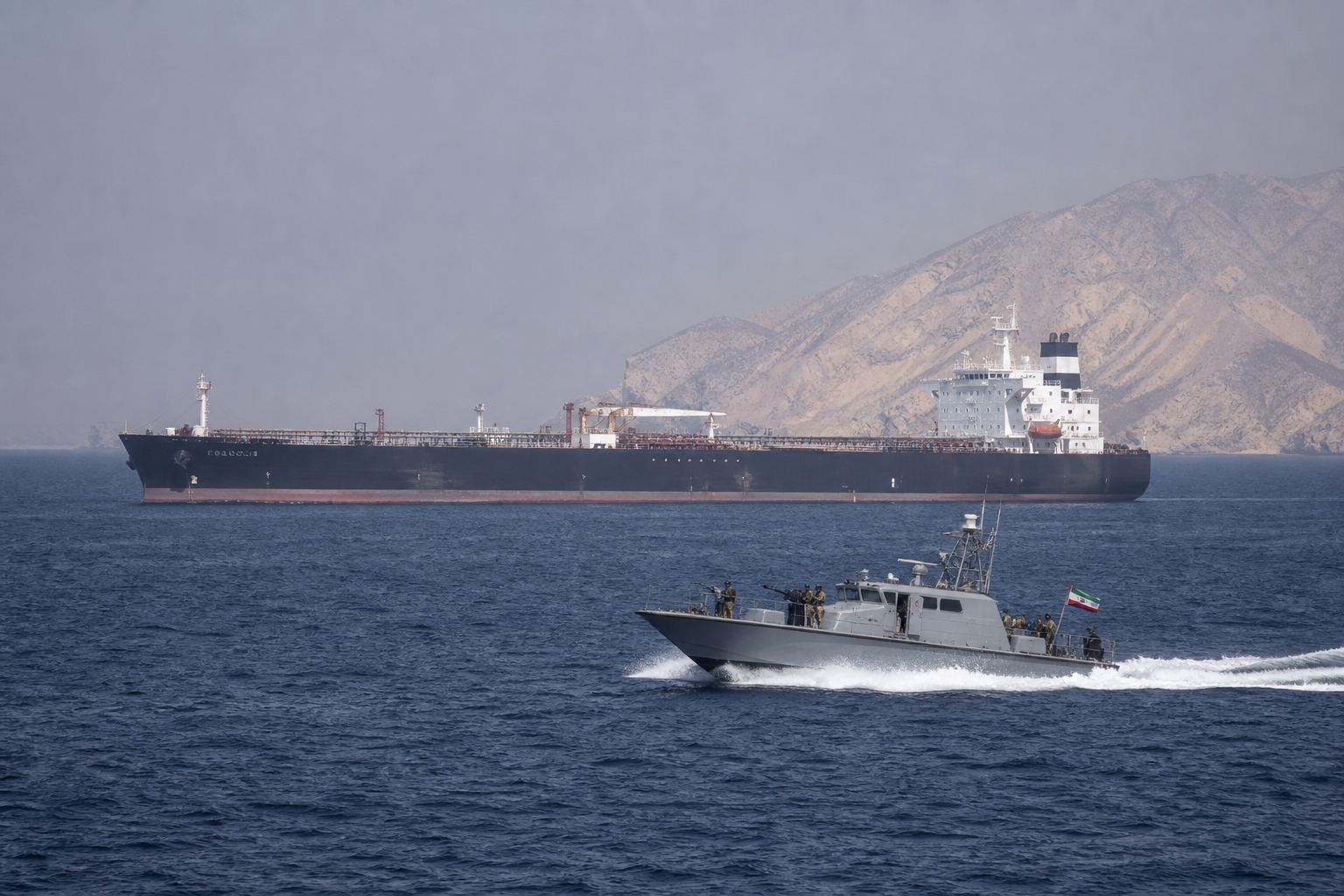
The Strait of Hormuz is one of those places most Americans rarely think about until events there threaten to raise gasoline prices at home. But that narrow waterway, sitting between the Persian Gulf and the Gulf of Oman, remains one of the world’s most important maritime chokepoints. A substantial share of globally traded oil and liquefied natural gas passes through it. That simple geographic fact gives Iran a powerful lever, and it is a lever Tehran has spent years rattling whenever regional tensions rise.
The immediate lesson is straightforward: even when Iran does not fully close the strait, its brinkmanship can still unsettle world energy markets, raise shipping costs, and test American credibility. In a global economy already accustomed to supply shocks, that sort of instability is not a side issue. It is a strategic problem.
Why the Strait Matters So Much
The Strait of Hormuz is narrow, crowded, and economically indispensable. Energy producers on the Persian Gulf rely on it to move crude oil and gas to world markets. Import-dependent economies in Asia are especially exposed, but the effects hardly stop there. Oil is a global commodity. Disruption in one vital corridor tends to ripple outward quickly, affecting insurance rates, futures markets, shipping patterns, and consumer prices far from the Gulf.
That is why even limited harassment matters. Iran does not need to sink every tanker or formally declare a blockade to create trouble. Seizing a vessel, shadowing commercial traffic, threatening mines, or staging military exercises near shipping lanes can be enough to inject fear into the market. Energy traders price risk as well as supply. If the route looks less secure, the world pays more.
That dynamic has made the strait a recurring pressure point for decades. Tehran understands that it cannot match the United States conventionally over the long run. What it can do, however, is exploit narrow vulnerabilities in the international system. It can create uncertainty cheaply and force more powerful countries to spend money, time, and political attention restoring normalcy.
Iran’s Strategy: Pressure Without Full-Scale War
Iranian brinkmanship in the Gulf is best understood not as random aggression, but as a method. The regime often operates in the space between peace and open war. It relies on calibrated threats, proxy activity, and limited direct action to signal resolve, deter pressure, and remind the region that no durable security arrangement can simply wish Iran away.
That approach serves several purposes at once. It can raise the cost of sanctions, complicate U.S. military planning, reassure hard-liners at home, and warn Arab neighbors against moving too closely into an anti-Iran coalition. It also gives Tehran room for deniability. A state that stops short of the most extreme act can claim it is merely responding to provocation, even as it steadily increases risk.
That ambiguity is part of the challenge. The United States and its allies are often left responding to a series of smaller confrontations rather than one unmistakable casus belli. Yet for energy markets, the distinction matters less than policymakers might like. A sustained pattern of intimidation can do real economic damage even absent a declared war.
The Economic Consequences Reach Well Beyond the Gulf
For American readers, the most visible consequence of a Hormuz crisis would likely be higher energy prices. The exact scale would depend on the severity and duration of the disruption, as well as broader supply conditions. But the mechanism is clear enough. If traders expect reduced flows or greater danger to shipping, crude prices tend to rise. Refiners, shippers, and insurers pass costs through the system. Consumers eventually feel it.
There is also a broader inflation angle. Energy prices affect transportation, manufacturing, and household budgets. At a time when voters remain sensitive to the cost of living, another externally driven energy shock would land on already strained political ground. Washington cannot control every world event, but it ignores these risks at its peril.
Europe and Asia would face their own pressures, especially countries heavily reliant on imported fuel. A Hormuz crisis can therefore become a test of alliance management as well as market resilience. If the United States is expected to help secure the world’s most important sea lanes, allies will expect both competence and clarity.
What a Serious U.S. Response Should Look Like
A prudent American response begins with an old but necessary principle: freedom of navigation is not self-enforcing. The United States has long played a central role in protecting maritime commerce, and there is no sign that mission has become obsolete. If anything, the global economy’s dependence on reliable shipping makes it more important.
That does not mean every provocation requires maximal escalation. It does mean that deterrence must be credible. A serious policy would include:
- Visible naval readiness to reassure commercial shipping and discourage opportunistic escalation.
- Close coordination with allies and regional partners so that maritime security is seen as a shared interest, not an exclusively American burden.
- Clear public signaling that attacks on commercial navigation will carry consequences.
- Economic and diplomatic pressure aimed at the regime and the networks that support destabilizing activity.
- Energy resilience at home through policies that strengthen supply flexibility and reduce vulnerability to foreign shocks.
That last point deserves more attention than it usually gets. Foreign policy hawks sometimes speak as though military power alone can solve strategic dependence. It cannot. A country serious about its freedom of action should also want durable energy strength at home. That means treating domestic production, infrastructure, and market flexibility as strategic assets, not merely environmental or partisan talking points.
Strength Abroad Requires Clarity at Home
Conservatives have long argued that deterrence works best when adversaries believe the United States means what it says. That remains true. But deterrence also depends on steadiness. Mixed signals, improvised red lines, and episodic attention invite testing. Tehran watches not only U.S. force posture, but also American political will.
There is a temptation in Washington to oscillate between overreaction and passivity. One side of the argument imagines every confrontation as the opening move of a larger war. The other treats each incident as manageable background noise. Neither approach is adequate. The better course is disciplined firmness: protect shipping, punish aggression proportionately, preserve escalation control, and keep the larger strategic purpose in view.
That purpose is not war for its own sake. It is the maintenance of a regional order in which vital trade routes remain open and coercion does not become normalized. The United States does not need to dominate every local dispute to defend that principle. It does, however, need enough consistency to make the principle believable.
A Test of Order, Not Just Oil
The Strait of Hormuz matters because it sits at the intersection of geography, economics, and power. When Iran engages in brinkmanship there, it is not merely creating a headline. It is probing the world’s tolerance for disorder and America’s willingness to uphold the basic rules of commerce and navigation.
That is why this issue should be understood as more than a temporary energy scare. It is a reminder that the world economy still depends on hard security, that hostile regimes exploit ambiguity, and that strategic neglect carries a price. The cost may first appear on a commodity screen or at the gas pump. But underneath it is a larger question about whether the institutions and powers that have kept sea lanes open still possess the confidence to do so.
For the United States, the answer should be yes. Not because every crisis can be mastered, and not because military power solves all things, but because a stable trading order remains one of the few genuinely indispensable public goods in international life. If America will not defend it where it is most vulnerable, others will draw their own conclusions — and the bill will come due far beyond the Gulf.
