
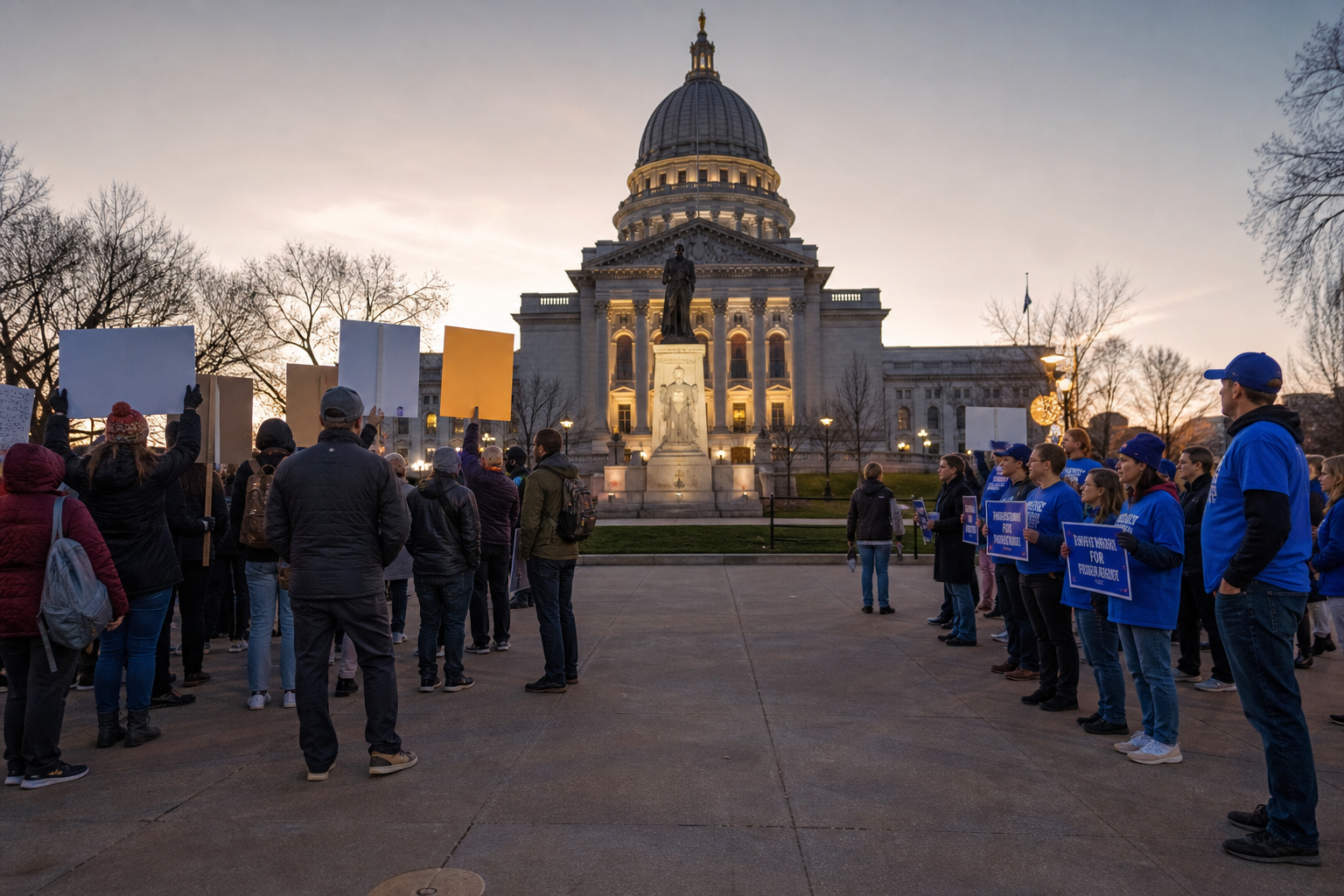
The Democratic Party's internal strains are no longer a matter for political hobbyists or cable-news panels. In several key states, the party is being pulled between center-left officeholders trying to hold together broad electoral coalitions and activist factions demanding sharper ideological confrontation on issues ranging from policing and immigration to energy policy and the war in Gaza. That tension is not unique to Democrats; every major party contains factions. But in closely divided states, where elections are won by persuasion at the margins, those divisions carry real consequences.
Republicans should be careful not to read every Democratic dispute as imminent collapse. American parties are resilient, and they are usually more pragmatic than their loudest voices suggest. Still, it would be a mistake to ignore what is plainly happening. The modern Democratic coalition includes affluent suburban moderates, union households, younger progressive activists, minority voters with varied social views, and institutional liberals who still think in terms of incremental governance. Those groups do not always want the same thing, and in swing states they often do not even speak the same political language.
Why the Divide Matters More in the States
National politics tends to flatten ideological conflict into slogans. State politics does the opposite. It forces parties to answer practical questions: How much should government spend? How aggressively should prosecutors pursue low-level crime? Should public utilities be pushed faster toward renewable mandates even if costs rise? How should school systems handle curriculum disputes and parental objections? On each of these questions, Democratic officeholders in competitive states face pressure from their left flank that can sit uneasily with the preferences of median voters.
This is especially true in states where the Democratic path to victory depends on a narrow alliance of urban progressives and center-left suburbanites. The activist class often treats any compromise as moral surrender. Elected officials, by contrast, must reckon with voters who dislike disorder, worry about affordability, and expect basic competence more than ideological purity.
That gap has become a defining problem for Democratic candidates in battlegrounds. The party's progressive wing has succeeded in shifting the terms of debate on many issues, but not always in ways that travel well beyond deep-blue districts. What sounds urgent in activist circles can sound doctrinaire to voters balancing school costs, mortgage rates, public safety, and the price of gasoline.
Three Fault Lines Driving the Conflict
1. Public order and policing
After the upheavals of 2020, many Democrats moved rhetorically left on criminal justice. Some local activists demanded cuts to police budgets or sweeping reductions in enforcement. In many jurisdictions, elected Democrats later adjusted course, emphasizing recruitment, accountability, and order rather than abolitionist language. That retreat itself tells the story. Voters in competitive areas may support reform, but they rarely support ambiguity about whether the state will enforce the law.
For institutional conservatives, this is a reminder of a basic truth: government has many purposes, but one of its first duties is to provide public order. A party that appears uncertain on that point invites backlash, particularly from working- and middle-class voters who do not have the luxury of insulating themselves from disorder.
2. Energy and cost of living
Another divide concerns climate policy and energy production. Progressive activists often demand aggressive mandates, litigation, and restrictions on fossil fuels. Democratic governors and legislators in manufacturing or energy-producing states tend to be more cautious, and for good reason. Utility bills, gasoline prices, and industrial jobs are not abstractions. They are the kinds of issues that turn ideological disagreements into voting behavior.
Conservatives need not deny environmental stewardship to make the obvious point: transitions imposed faster than technology, infrastructure, and family budgets can bear will produce political resistance. In key states, Democrats are feeling that pressure from both directions, with activists demanding moral urgency and voters demanding economic realism.
3. Immigration, protest politics, and nationalized messaging
The party's internal tension is also sharpened when national activist causes dominate local campaigns. Immigration is a good example. Democratic officeholders in swing states often favor a combination of legal immigration, border management, and work authorization reforms. Activist rhetoric, however, can slide toward a language of near-total moral indictment of enforcement itself. That may energize some constituencies, but it leaves many ordinary voters wondering whether anyone in power takes national sovereignty seriously.
The same is true of protest politics tied to international conflicts. Candidates running for state office are increasingly asked to adopt maximalist positions on foreign policy disputes that have little to do with the management of state government. Yet refusal to do so can trigger primary challenges, donor backlash, or activist condemnation. Parties that cannot distinguish between symbolic politics and governing priorities eventually pay a price for that confusion.
Primaries Reward Intensity, General Elections Reward Breadth
This is the structural problem beneath the headlines. Primary electorates are usually smaller, more ideological, and more activist-driven than the general electorate. That means Democratic candidates in safe or semi-safe areas are rewarded for taking sharper positions, while candidates in competitive districts must later explain, soften, or reframe those same positions. The party then spends time and money managing the translation.
That pattern is not new. What is different now is the speed with which activist expectations spread through social media, donor networks, and nationalized issue campaigns. A state legislator in a Midwestern suburb can face pressure to echo the language of activists in Brooklyn or San Francisco, even if his or her own district is culturally and politically distinct. That is not a formula for durable majorities. It is a formula for message drift.
What Republicans Should Learn From It
There is an easy temptation here for Republicans: assume that Democratic infighting will simply hand over elections. Politics is rarely that generous. Voters unhappy with progressive overreach do not automatically embrace the GOP; they must be given a credible alternative. If Republicans want to benefit from Democratic divisions, they need to offer steadiness, not just mockery.
That means focusing on the concerns that animate persuadable voters in key states:
- Affordability: inflation-sensitive household budgets, taxes, housing, and energy costs.
- Public order: support for law enforcement alongside serious accountability.
- Institutional competence: schools that teach, agencies that function, and infrastructure that gets built.
- Constitutional restraint: an argument for limited government that is practical rather than abstract.
If Republicans instead mirror the Democrats' own temptations toward performance politics, they will squander the opening. The lesson of divided government in a polarized age is that voters often choose the side that seems more normal, more disciplined, and more capable of governing.
A Party at Odds With Its Own Coalition
The Democratic Party's challenge in key states is not that it has progressive members. Every broad party has ideologues. The challenge is that its activist left often exerts influence beyond its electoral footprint, while many of the voters needed to win statewide races remain more moderate, more institutional, and more skeptical of ideological crusades than party elites sometimes assume.
That creates a recurring contradiction. Democrats want to be the party of activist energy and managerial competence at the same time. Sometimes they succeed. But when activist demands outrun public consent, the coalition frays. In state after state, that is the real story: not a melodramatic "civil war," but a persistent conflict between movements that want transformation and voters who mainly want order, affordability, and responsible government.
In the end, parties are judged not by the intensity of their internal debates but by whether they can govern a large, diverse republic. On that test, Democrats in battleground states are under growing strain. And unless they can re-establish a clearer hierarchy of priorities, they may find that ideological fervor is a poor substitute for political durability.
