
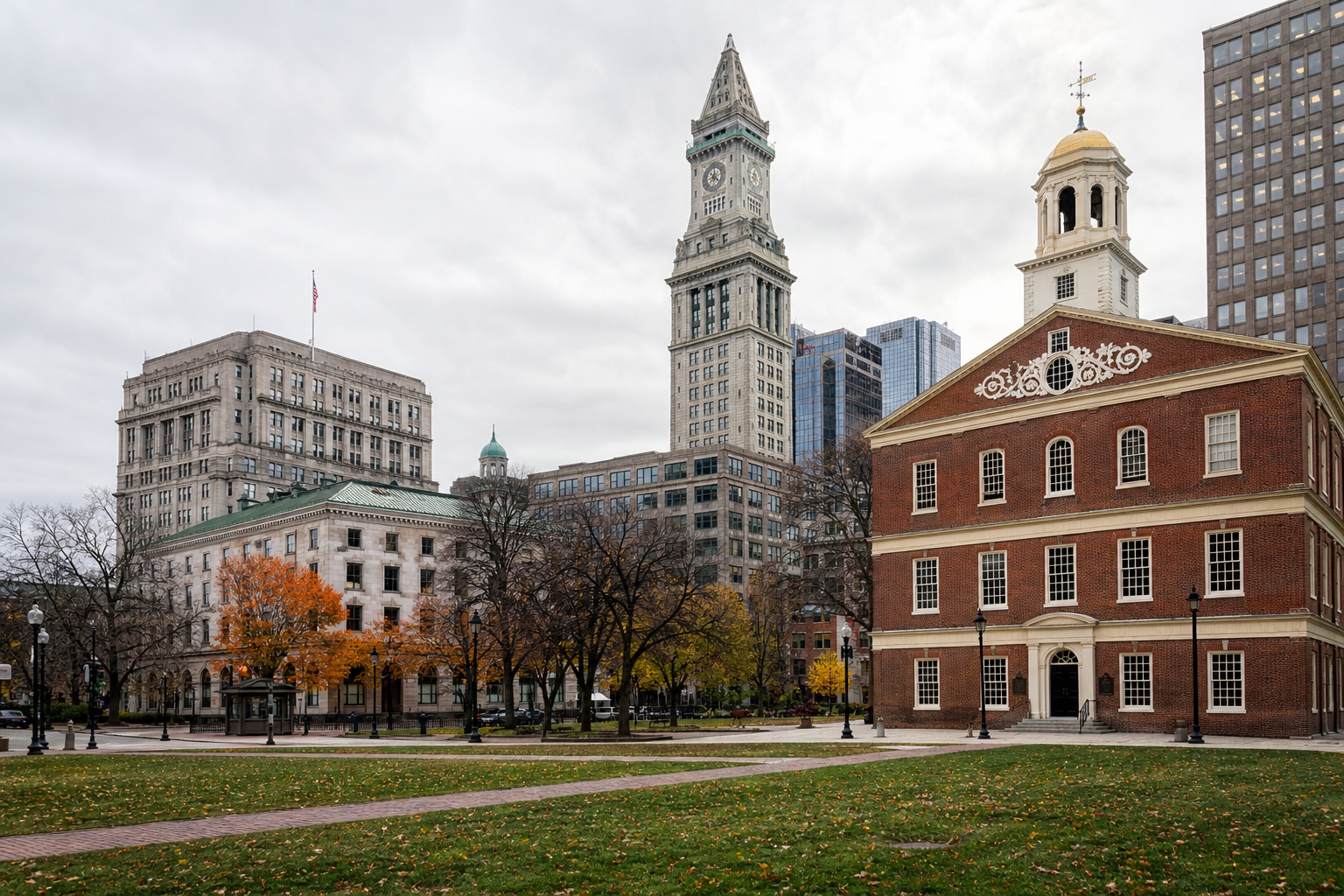
When Cities Redefine National Observances
Boston's recent declaration of a "Day of Mourning" raises a question that runs deeper than any single municipal ordinance: Who has the authority to reshape the civic calendar, and what happens when local governments reinterpret traditions that have long belonged to the whole nation?
The question matters because it touches on something conservatives have long worried about—the incremental displacement of shared national symbols and observances by rival interpretations offered from the top down by institutional actors with their own agendas. This is not, on its face, a question of left versus right. It is a question about how change happens in a republic, and who gets to decide what we remember, and how.
The Case in Context
Municipal governments have always retained broad authority over local observances and proclamations. Mayors declare weeks, days, and hours in honor of causes, groups, and events. This is ordinary and, within reason, unremarkable. The power to do so has rarely been centralized; it flows naturally from local executive authority.
What distinguishes recent instances from the routine is the deliberateness with which some cities have adopted alternative framings of established national days—not merely adding a local emphasis, but effectively superseding or reinterpreting the original meaning. When a major city officially declares a holiday that competes with or recontextualizes a national observance, it sends a signal about whose version of history, whose grievances, and whose narrative will dominate that moment in that place.
For conservatives who have invested in the premise that American institutions should transmit a coherent national story, this matters. It suggests that the civic calendar itself has become contested ground.
The Institutional Question
There is a conservative impulse to defend institutions—to say that some things, like how we collectively mark time, should not be constantly remade by whoever holds power today. That impulse is not backward-looking nostalgia; it is a recognition that shared rituals and symbols are what hold a diverse nation together across deep disagreement. When those symbols become vehicles for competing narratives about what America is and what it has done, they lose their unifying power.
The question is not whether cities have the legal right to declare observances. They do. The question is whether the constant contestation of shared civic traditions is healthy—whether it reflects legitimate public debate, or whether it signals that we have lost confidence in the idea that Americans might remember the same events in roughly the same way.
Who Controls the Narrative?
Boston's declaration, like similar moves in other cities, reflects a view that the civic calendar should be used as an instrument of historical revision—that official recognition is a way of correcting what progressive actors see as past oversights or injustices in how we remember ourselves. This is not irrational or illegitimate as a goal. The problem is that it treats the civic calendar as a tool of ideological instruction rather than as a commons.
When a mayor uses municipal authority to declare a "Day of Mourning" on a date previously used for a different national observance, the message is clear: This city's official story is not your national story. This is especially significant when the reinterpretation is offered without broad public deliberation, but rather as a fait accompli from elected officials implementing their vision of proper historical consciousness.
Conservatives who care about institutional integrity should note this pattern—not to forbid cities from making such declarations, but to recognize what it signals about how much confidence remains in the national project itself. When large institutions begin systematically offering competing versions of who we are and what we remember, it is a sign that a nation is fragmenting, one proclamation at a time.
The Deeper Pattern
This is part of a larger story about how the left has approached American institutions over the past generation. Rather than argue for outright replacement, the strategy has often been to repurpose them from within—to use their authority and legitimacy to advance a reinterpreted version of American history and meaning. Schools, universities, government agencies, and municipal authorities have all become sites where the American story is being rewritten by those who control them.
Conservatives can respond in a few ways. One is to fight each instance individually—to defend particular days or observances. Another is to recognize that these are symptoms of a deeper loss of consensus, and to ask why that consensus has eroded. A third is to offer their own compelling, historically grounded account of American achievement and responsibility, one honest about failures and consistent in its principles.
What conservatives should not do is treat these moments as culture-war victories or defeats. They are neither. They are signs that the civil religion that once held Americans together across difference is fraying, and that those who now control major institutions are offering different stories about what binds us together.
Moving Forward
The immediate response to Boston's declaration might be to object on principle. But the more durable conservative response is to ask what comes next. If municipalities are free to redefine civic occasions, what becomes of shared national time? And if shared national time fragments into competing local narratives, what holds a nation together at all?
These are not rhetorical questions. They are institutional questions that conservatives, who have always believed that institutions matter more than individuals, should take seriously. The answer is not to centralize control or to forbid cities from their municipal prerogatives. It is to rebuild consensus around why we remember certain things, and to make the case that some symbols and days ought to belong to all of us, not to whoever can claim them most loudly.
