
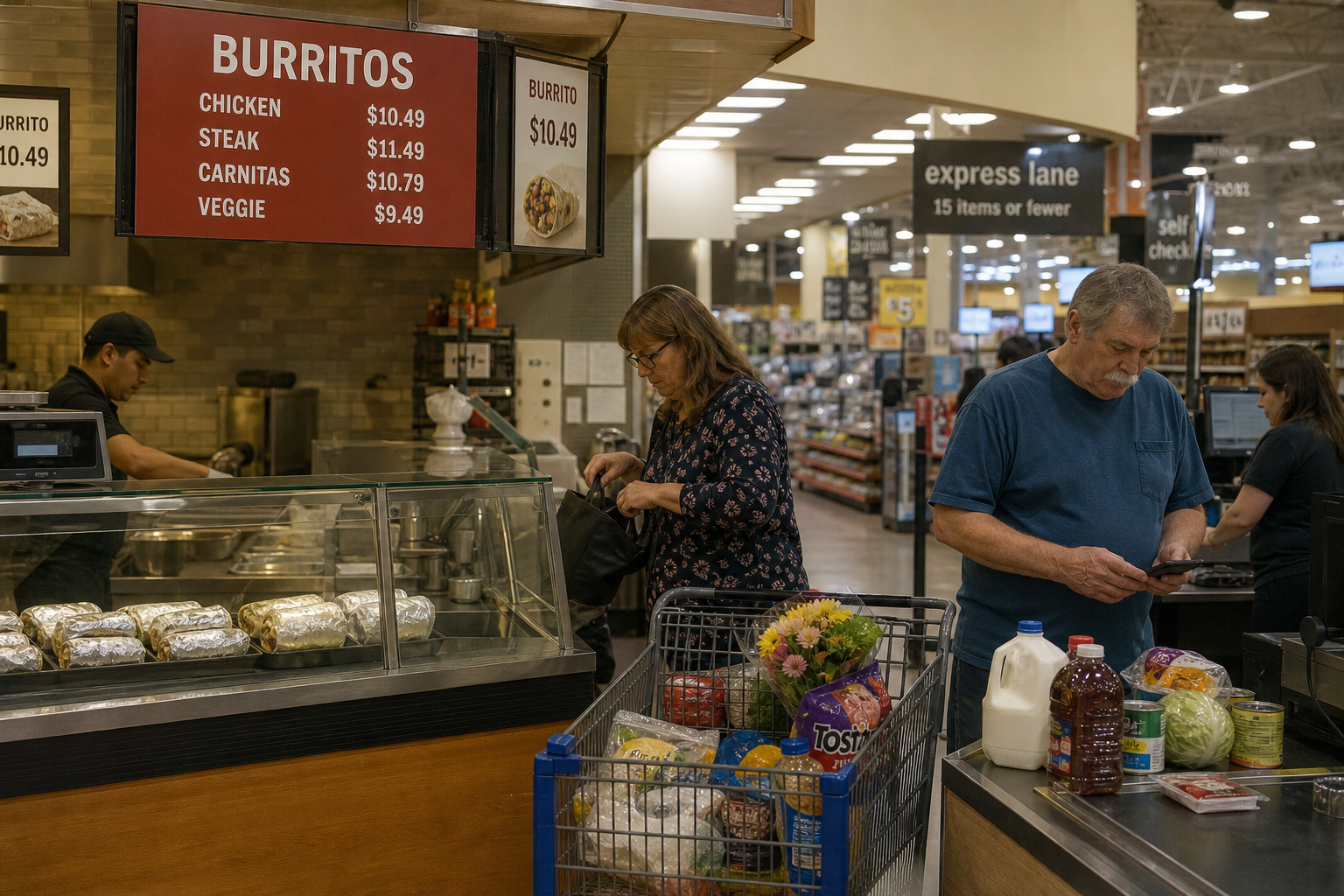
Inflation has a way of becoming abstract in Washington and painfully concrete everywhere else. Economists debate core measures, annualized rates, and monetary transmission. Families notice that dinner out costs more, ground beef costs more, and the weekly grocery run still lands with a thud. Whether the item is a burrito at a fast-casual counter or milk and cereal at the supermarket, the underlying complaint is the same: prices rose sharply, and many of them never really came back down.
That distinction matters. Inflation is not simply about whether prices are still rising at the same pace they were a year or two ago. It is also about the higher price level that households must now live with. Even as the rate of inflation has cooled from its peak, Americans are still carrying the consequences of the surge that began in 2021. Wages have risen in many sectors, to be sure, but so have housing, insurance, utilities, food, and borrowing costs. That is why the public remains unconvinced by official reassurances. People are not imagining the squeeze. They are living it.
The inflation story was never just one thing
It is tempting to search for a single villain. Corporations, supply chains, energy producers, labor shortages, global conflict, the Federal Reserve, Congress, pandemic disruption, consumer demand — each has been assigned the role at one point or another. But persistent inflation in the United States came from a convergence of forces, some unavoidable and some plainly the result of public policy.
The first layer was the pandemic shock itself. Supply chains buckled, factories slowed, ports clogged, and patterns of demand shifted suddenly from services to goods. Americans bought more furniture, appliances, home electronics, and groceries, while restaurants and travel initially sagged. That imbalance alone would have raised prices.
But Washington did not stop at cushioning the blow of a temporary emergency. The federal government poured extraordinary sums into the economy through multiple rounds of spending, some enacted under bipartisan pressure and some passed after the immediate crisis had begun to ease. At the same time, the Federal Reserve held interest rates very low for too long and continued large-scale asset purchases well into the recovery. More money chased too few goods. That is not a slogan; it is the basic arithmetic of overheated demand.
Then energy costs rose, both because of global market pressures and because domestic policy sent a confused signal about the place of conventional energy production in the American economy. No president controls oil prices by decree, and serious analysts should resist that kind of simplification. Still, policy choices can either encourage stable supply or discourage investment at the margins. Energy is not a niche input. It runs through transportation, manufacturing, heating, farming, and food distribution. When energy becomes more expensive, almost everything else eventually does too.
Why food prices remain politically potent
Food inflation has a special place in public frustration because it is so visible and so frequent. Most Americans may not buy a car every year or refinance a mortgage every month, but they do buy groceries every week. They notice when eggs jump, when beef costs more by the pound, and when a quick family meal now feels like a luxury rather than a convenience.
Restaurants and prepared food businesses face the same pressures. Their costs include ingredients, wages, rent, utilities, packaging, and transportation. When all of those rise together, menu prices follow. A more expensive burrito is not a cultural curiosity. It is a compact lesson in inflation economics. The tortilla, meat, cheese, produce, electricity, lease, and labor behind it have all become costlier.
This is one reason political leaders often struggle to persuade the public that inflation is under control. Official indexes may show improvement in the rate of increase, but consumers are responding to the level of prices they see in ordinary life. They are comparing today's receipt not only with last month but with what that same cart of groceries cost before the inflation spike began.
The Federal Reserve can cool demand, but it cannot undo bad governance
The Federal Reserve has one powerful tool for fighting inflation: making money more expensive through higher interest rates. That can slow demand, reduce borrowing, and eventually ease price pressures. But it is a blunt instrument. It cannot repair supply chains, produce more housing, refine more fuel, or legislate restraint in Congress. It can only suppress demand enough to bring it closer to available supply.
That helps explain the bind the country has been in. To correct the inflationary excess, the Fed tightened policy sharply. Yet the consequences of that tightening have not been painless. Higher rates raise the cost of mortgages, business investment, auto loans, and credit card debt. So Americans have been asked to absorb both the lingering price shock from the inflation surge and the cost of the medicine used to contain it.
This is where public policy deserves a more honest accounting than it often receives. Inflation was not merely an act of nature. It was aggravated by a governing class too willing to treat emergency spending as a standing habit, too slow to recognize inflation risks, and too eager to assume that short-term fiscal stimulus carries no long-term price.
What a more responsible policy approach would look like
A conservative response to inflation should begin with seriousness about limits. Government cannot spend at crisis levels indefinitely without consequences. Nor can it run chronic large deficits and assume financial markets will forever absorb them without demanding higher borrowing costs. Fiscal discipline is not a moral ornament. It is part of price stability.
A more durable anti-inflation agenda would include several basic commitments:
- Greater restraint in federal spending, especially outside genuine emergencies.
- More predictable energy policy that supports reliable domestic production while allowing innovation and competition.
- Regulatory reform where unnecessary rules drive up transportation, construction, and business costs.
- Housing supply reforms, particularly at the state and local level, to address one of the most stubborn contributors to household cost pressures.
- Monetary sobriety, meaning a Federal Reserve that responds to inflation risk earlier and communicates more clearly about tradeoffs.
None of these steps offers the instant political gratification that modern campaigns prefer. There is no single bill that can roll prices back to 2019. That is the difficult truth. In most cases, once inflation has lifted the general price level, the task is not to force broad prices down outright but to restore conditions in which wages, productivity, and supply can catch up without another inflationary spiral.
The deeper problem is a crisis of credibility
There is also a political lesson here. Americans lose trust when leaders insist the economy is strong while families feel weaker. The public can accept hard news more readily than it can accept obvious spin. If groceries, rent, and insurance remain elevated, voters will not be soothed by selective metrics or triumphal language.
A healthier politics would begin by admitting what inflation has done: it has acted as a tax on prudence, punishing households that budget carefully and save modestly. It has eroded confidence in expert management and in the capacity of institutions to anticipate predictable consequences. And it has reminded the country that economic policy is not an academic exercise. It reaches all the way down to the checkout line.
That is why the inflation debate still matters, even after the worst of the spike has passed. The question is no longer simply how prices rose so quickly. It is whether the country has learned the right lessons from the episode. If Washington concludes that massive spending, delayed monetary correction, and muddled supply-side policy carry little cost, then the next inflation cycle will not be an accident. It will be a choice.
