
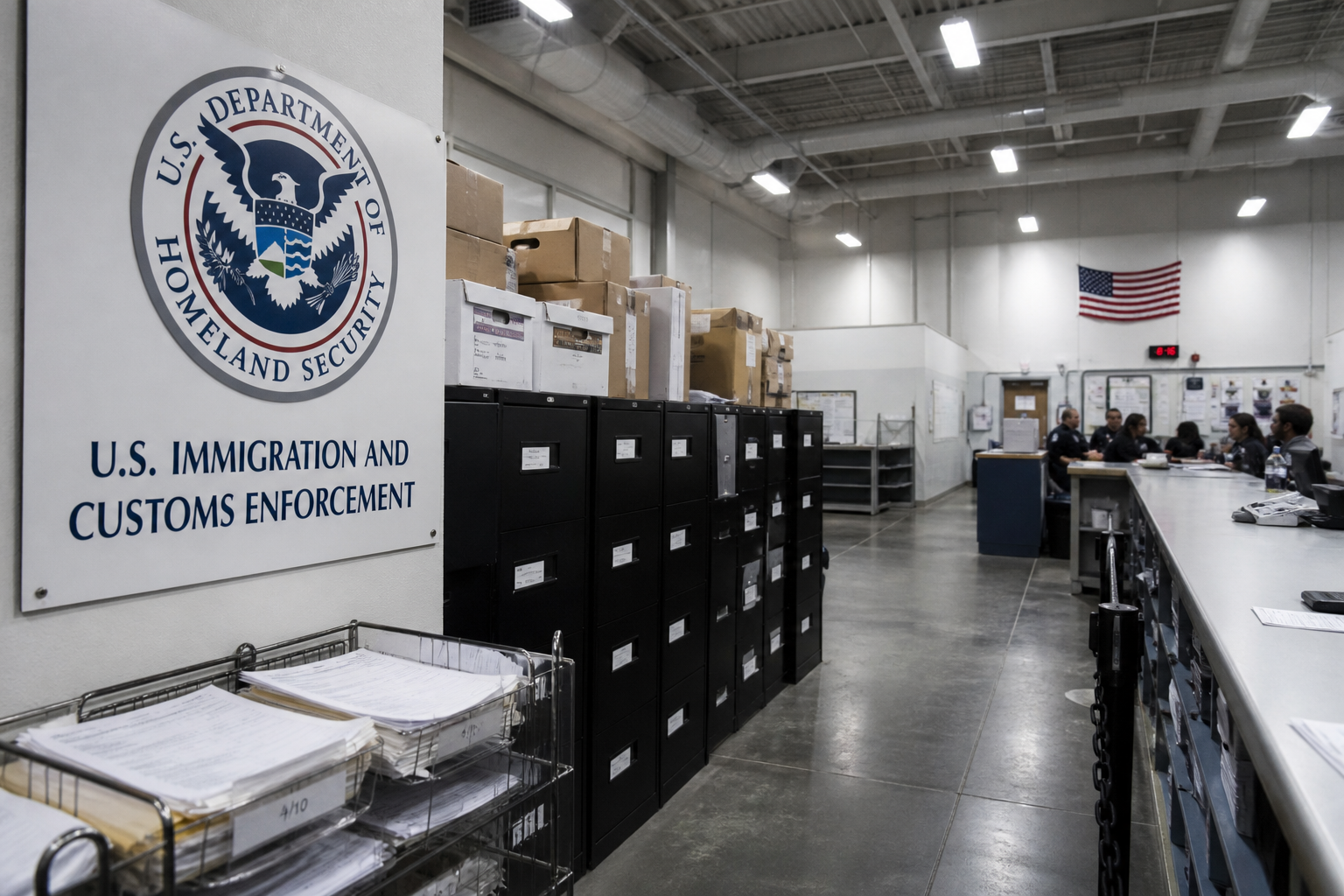
When Immigration Fraud Exploits Open Policies, Law Enforcement Pays the Price
The machinery of federal law enforcement operates under a peculiar strain these days, caught between two competing pressures: the need to enforce existing immigration law and the reality that enforcement resources are finite. When immigration fraud schemes flourish—identity theft rings, falsified asylum claims, document forgery networks—the result is not merely a matter of individual cases. It becomes a systemic problem that degrades the legitimacy of the entire immigration system and stretches already-thin enforcement capacity to the breaking point.
This tension sits at the heart of a broader policy problem that conservatives have long identified but that mainstream discussion often glosses over. The issue is not simply about the volume of immigration, though that matters. It is about whether immigration policy can function as law at all when fraud schemes render enforcement haphazard and inconsistent.
The Architecture of Immigration Fraud
Immigration fraud takes many forms. There are asylum claims filed in bad faith, often facilitated by smuggling networks that coach migrants on what American officials want to hear. There are falsified documents—work permits, travel papers, identification credentials—produced by sophisticated criminal enterprises operating across borders. There are identity theft operations that exploit Social Security numbers and legal resident status to enable employment fraud, document abuse, and benefit fraud.
What unites these schemes is that they all undermine the integrity of immigration law itself. They convert immigration policy from a coherent set of rules into something closer to a lottery, where compliance and fraud yield roughly similar outcomes. When someone who entered the country fraudulently faces minimal consequence while someone who followed proper procedures waits years in processing queues, the system loses its moral standing.
Federal law enforcement agencies—Immigration and Customs Enforcement (ICE), Customs and Border Protection (CBP), and the FBI's immigration fraud units—are tasked with detecting and prosecuting these crimes. But they operate with budgets that have not kept pace with the scale of the problem. A single identity theft ring can compromise thousands of individuals and countless benefit programs, yet the resources devoted to investigating and prosecuting such cases remain modest by comparison.
Why Open Policies Create Opportunities
There is a direct relationship between permissive immigration policies and the proliferation of fraud. When asylum standards are loosely applied, when documentation requirements are minimal, when enforcement is sporadic, the incentive structure for fraud increases dramatically. This is not a matter of opinion; it is basic economics. If the probability of detection is low and the consequence of detection is delayed or uncertain, more people will attempt to game the system.
This does not mean that everyone seeking entry through legal channels is inclined to commit fraud. Most are not. But at the margins—where organized criminal networks operate—permissiveness is an invitation. Smugglers and document forgers have sophisticated knowledge of how immigration systems work and where enforcement is weak. They adapt their operations accordingly.
Conservative immigration policy traditionally rested on a simple principle: clear rules, fairly enforced. The underlying theory was that people respect systems they perceive as orderly and just. But that theory only works if systems actually function that way. When policies are so porous that fraud becomes routine, the entire apparatus loses legitimacy in the eyes of both enforcement personnel and the general public.
The Burden on Law Enforcement
Federal agents tasked with immigration enforcement find themselves chasing an endless stream of individual cases without meaningful ability to address the structural problems beneath them. An ICE officer who apprehends someone with a fraudulent visa can process a deportation, but if similar cases number in the thousands and resources allow for only a fraction to be pursued, individual enforcement efforts feel futile.
This breeds a particular kind of institutional demoralization. Agents understand that they are clearing cases, not solving problems. They see the same schemes repeat because the underlying conditions that enable them remain unchanged. Over time, this reality can erode the professional morale of law enforcement, which depends partly on the sense that one's work contributes to a coherent policy outcome.
Moreover, when fraud cases are numerous but resources are stretched, law enforcement must make triage decisions about which cases to pursue. That inevitably means that many lower-level fraud cases go unaddressed, creating a de facto amnesty for categories of fraud. This, in turn, sends a signal to potential fraudsters that certain schemes carry minimal risk.
Restoring Institutional Integrity
From a conservative institutional perspective, the problem is not primarily about immigration levels in the abstract. It is about whether immigration law functions as law. That requires that rules be clear, that enforcement be reasonably consistent, and that consequences be meaningful and prompt.
Addressing immigration fraud schemes is not a matter of ideology. It is a matter of institutional maintenance. It requires adequate resources for investigation and prosecution. It requires that asylum standards be applied consistently and that documentation requirements be genuinely enforced. It requires, also, that consequences for fraud be significant enough to deter criminal networks from making it a core business strategy.
This is not primarily about closing borders or adopting restrictive immigration policy. It is about making whatever policy exists actually function as law. A moderately restrictive immigration system that is consistently enforced will have more integrity and generate more public respect than a permissive system riddled with fraud and selective enforcement.
The challenge for policymakers is that addressing fraud requires sustained political will—and sustained funding—over years. It is not glamorous work. It happens in federal buildings and administrative courts rather than on cable news. But it is essential if immigration policy is to retain legitimacy.
Until that work is done, federal law enforcement will continue to shoulder an unfair burden, chasing symptoms rather than addressing causes. That serves neither effective immigration enforcement nor the interests of the law-abiding people trying to navigate the system properly.
