
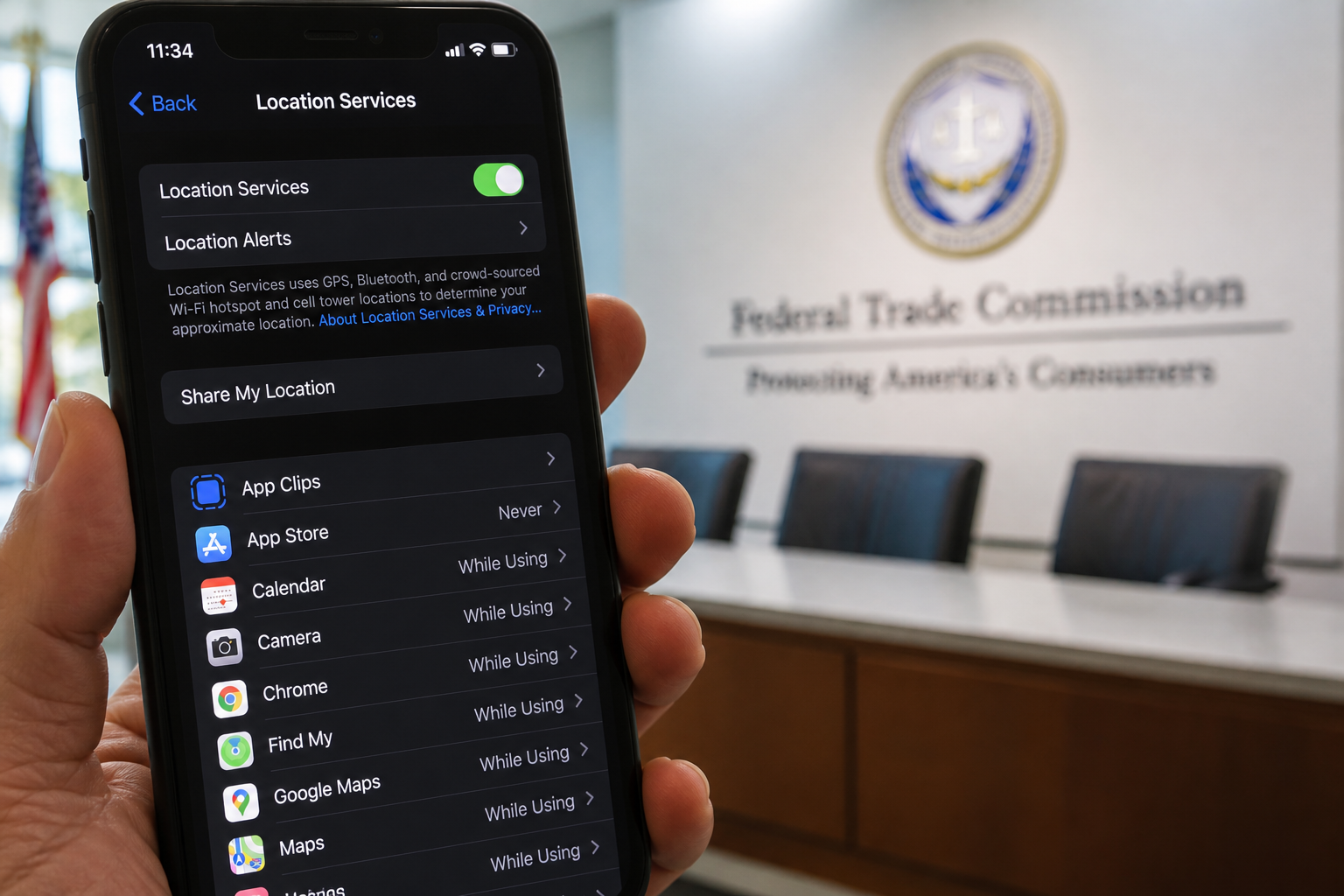
The FTC's Action Against Location Data Sales Raises Questions About Privacy, Property, and Power
The Federal Trade Commission has moved against data brokers who buy and sell smartphone location information without explicit user consent. The action reflects a growing concern in Washington—and among ordinary citizens—about the collection and monetization of personal data by companies operating largely outside public view. It also illustrates a broader tension in American governance: how to protect privacy without resorting to heavy-handed regulation that stifles innovation and commerce.
The specifics are worth understanding. Data brokers are firms that aggregate information from various sources—location pings from apps, web browsing history, purchase records—and package it for sale to marketers, insurers, and other commercial interests. The business model is profitable precisely because it operates below the waterline of public attention. Most users do not know their location data is being harvested and sold. Those who suspect it often have limited practical ability to stop it, because the data collection happens through labyrinthine chains of third-party vendors and consent forms buried in app terms of service.
The FTC's enforcement action sends a signal that this arrangement has crossed a line the agency believes it can and should regulate. That message will resonate differently depending on one's view of privacy as a property right, a consumer protection issue, or something else entirely.
Why This Matters to Conservatives
Institutional conservatives generally hold three commitments that are relevant here. First, they believe in the rule of law and the proper exercise of regulatory authority by agencies within their delegated authority. Second, they value property rights—including the notion that individuals own information about themselves. Third, they are skeptical of unchecked corporate power and monopolistic behavior.
From that perspective, there is legitimate concern about data brokers operating in a regulatory gray zone. If individuals have a property interest in their own data—a position grounded in both common sense and emerging legal doctrine—then the surreptitious sale of that data without consent looks less like commerce and more like theft. The fact that consent is technically buried in a terms-of-service document does not render it meaningful consent; it is consent extracted through market power and information asymmetry, which is not consent at all in any serious sense.
The counterargument, pressed by tech companies and data brokers, is that location data enables valuable services—from navigation apps that work because they collect aggregate location data, to advertising models that keep digital services free. There is some truth to this. The question is whether that value justifies the sale of individualized location data without affirmative, clear consent.
The Regulatory Approach and Its Limits
The FTC has some authority to police deceptive or unfair practices, but its legal powers are not unlimited. The agency can bring enforcement actions, impose fines, and demand injunctions. What it cannot easily do is write substantive privacy law—that is fundamentally a legislative function. Congress has the authority and responsibility to clarify what privacy protections ought to exist, how they should be enforced, and what exceptions should apply.
This distinction matters because regulatory agencies, left to their own devices, tend to expand their authority and impose rules that become rigid and difficult to update as technology evolves. The FTC's current action may well be justified, but it operates against the backdrop of decades of regulatory mission creep. A more durable solution would involve Congress setting clear parameters: what data can be collected, under what circumstances, with what safeguards, and with meaningful remedies for consumers when those rules are broken.
Such a law would ideally balance competing interests. It should protect individual privacy and property interests in personal data. It should provide clarity to businesses about what practices are permissible. It should preserve room for legitimate commercial uses of aggregate or properly anonymized data. And it should avoid imposing such rigid compliance costs that only the largest firms can afford to comply, which would entrench monopolies rather than break them.
What Happens Next
The FTC's current enforcement action will likely face legal challenges. Companies subject to the agency's orders will argue that the FTC is exceeding its statutory authority or imposing rules that lack adequate congressional authorization. These are not frivolous arguments. At the same time, Congress could intervene—either to endorse the FTC's approach through legislation, to constrain it, or to establish its own baseline privacy protections that preempt the patchwork of state laws and regulatory interpretations.
From a conservative standpoint, the preferable path is legislative. Congress should act to establish clear rules that protect consumer privacy in location data, require affirmative consent for data sales, and provide meaningful remedies. Such a law should be technology-neutral enough to survive changes in how data is collected, but specific enough to give businesses and consumers clear expectations.
The underlying principle is sound: individuals should not have their personal information appropriated and sold without their knowledge and consent. The mechanism for protecting that principle matters. Regulatory agencies can enforce the law, but Congress must write it. Until it does, the FTC will continue to operate within the margins of its authority, drawing criticism and resistance from all sides. A legislative solution would be messier than agency action, but ultimately more democratic and more durable.
