
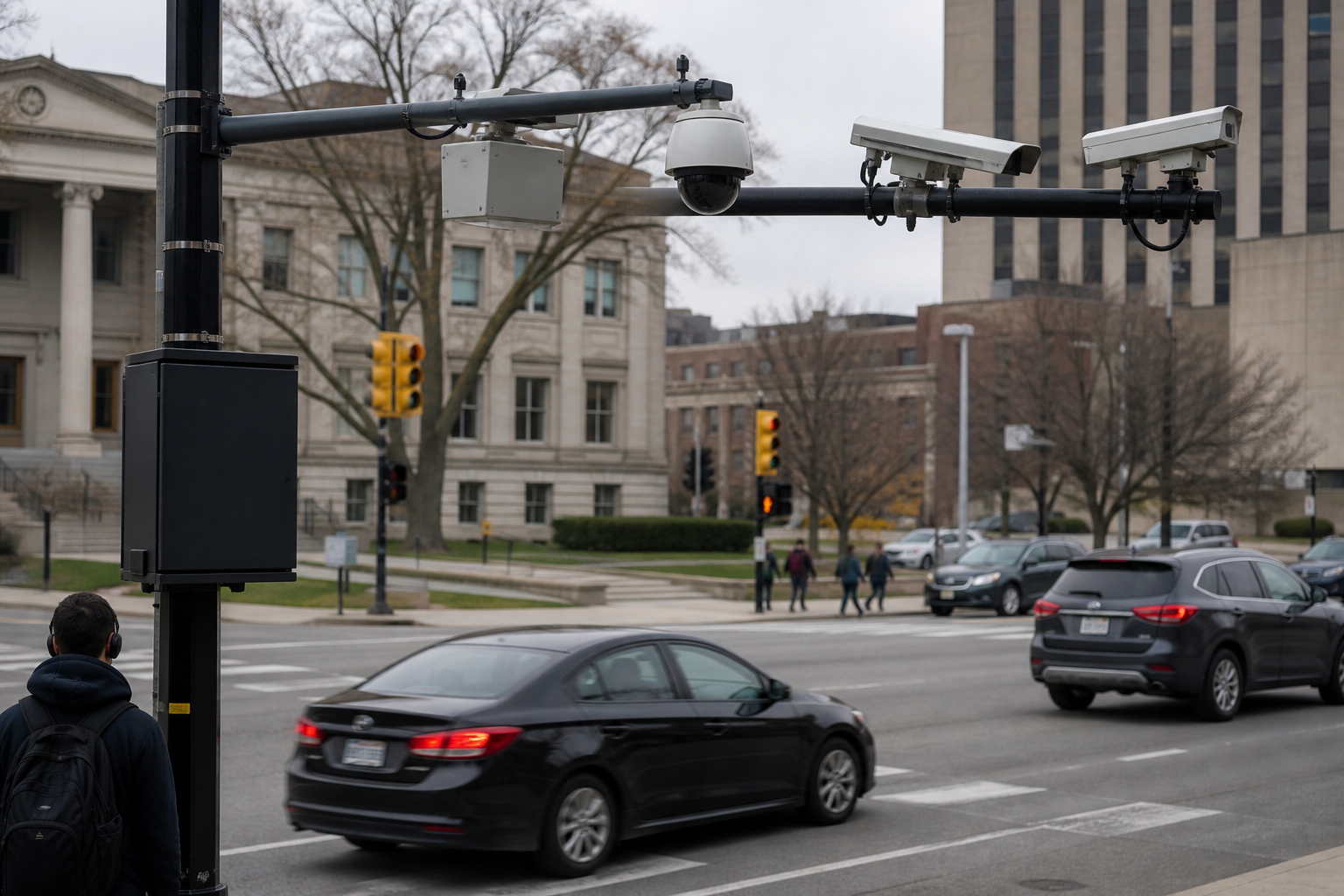
Local governments across the country have embraced automated license plate reader systems for a simple reason: they work. Police departments use them to locate stolen cars, identify vehicles linked to serious crimes, and piece together timelines that would have been far harder to build a generation ago. In an era when many cities are under pressure to do more with fewer officers, the appeal of technology that can scan and store large volumes of vehicle data is obvious.
But obvious usefulness is not the same thing as constitutional clarity. The spread of license plate reader cameras has outpaced the legal rules that ought to govern them, and that should concern anyone who takes the Fourth Amendment seriously. A conservative approach to public order has always rested on two principles at once: government must keep the peace, and government power must be limited, accountable, and subject to clear rules.
Right now, on this issue, the second principle is lagging badly behind the first.
What Plate Readers Actually Do
Automated license plate readers, often called ALPRs, capture images of passing vehicles and convert plate numbers into searchable data. Many systems also log the date, time, and location of the scan, and some retain a photograph of the vehicle itself. Departments can then compare plate numbers against lists associated with stolen vehicles, warrants, or other law-enforcement alerts.
That narrower use case is easy to defend. If a patrol officer can look at a plate in plain view, there is nothing inherently unreasonable about technology helping do the same task more efficiently. Courts have long recognized that drivers traveling on public roads have a reduced expectation of privacy in what they openly display to the public.
The problem begins when temporary observation becomes mass retention. A single officer spotting one car on one street is not the same thing as a citywide or even nationwide network storing a detailed record of where millions of innocent people have driven over weeks or months. At that point, what is being built is not just a tool for solving crimes. It is an architecture for tracking movement.
The Fourth Amendment Question
The Fourth Amendment was written to restrain general searches and arbitrary government intrusion. The text predates cameras, databases, and cloud storage, but the principle is not antiquated. If anything, modern technology makes the principle more important. Government now has the capacity to collect information at a scale the framers could not have imagined. That should not make constitutional limits less relevant; it should make them more urgent.
The Supreme Court has already signaled, in several technology-related cases, that sheer aggregation matters. The Court has recognized that prolonged tracking and the collection of detailed digital records can raise constitutional concerns distinct from any single observation made in public. That does not automatically settle every question about plate-reader systems, but it does point in the same direction: the law should not pretend that thousands of location points are equivalent to one passing glance.
This is where many cities have been too casual. Some jurisdictions have retention policies. Others do not. Some limit access to sworn law-enforcement personnel. Others allow broader sharing. Some require audits and documented reasons for database searches. Others rely on internal discretion. This patchwork approach is not sustainable, and it is not especially conservative. A free society should not depend on the hope that every local agency will write wise rules for itself.
Why Federal Standards Are Necessary
There is often a healthy instinct on the right to leave policing matters to states and localities. In many cases that instinct is sound. But when a surveillance technology becomes widespread, interoperable, and capable of crossing jurisdictional lines with ease, basic national privacy standards become appropriate.
That is not a call for Washington to run local police departments. It is a call for Congress to set guardrails for the use, storage, sharing, and auditing of highly sensitive location data. Federal law already sets privacy rules in other areas where the stakes are high and the incentives to overcollect are strong. There is no reason location tracking by government should remain comparatively underdefined.
A sensible federal framework would do at least four things:
- Limit retention periods for data not connected to a specific investigation, so routine scans of innocent drivers are not stored indefinitely.
- Require a documented law-enforcement purpose for database queries, with audit trails and penalties for misuse.
- Restrict data sharing across agencies and with private vendors unless clear legal standards are met.
- Require warrants or court approval for prolonged historical tracking of a particular vehicle, absent exigent circumstances.
None of this would prevent police from using plate readers to identify a stolen car in real time or to pursue a suspect in an emergency. It would simply distinguish targeted law enforcement from dragnet collection.
Private Vendors and Public Accountability
Another difficulty is that many ALPR systems are built, hosted, or maintained by private companies. That can blur responsibility. When government relies on private platforms to gather and store public data, citizens may have less visibility into who holds the information, how long it is kept, and with whom it is shared.
That arrangement should make lawmakers cautious. Constitutional protections should not weaken simply because a city outsourced part of the surveillance process. If public agencies can obtain broad location histories through contractor databases without robust oversight, then the practical effect is to evade the discipline the Constitution is supposed to impose.
Conservatives, of all people, should be alert to this risk. Skepticism of concentrated power is not limited to federal bureaucracies. It applies just as much to public-private systems that accumulate sensitive information with little public scrutiny.
Public Safety and Liberty Are Not Opposites
There is a lazy habit in modern politics of treating every privacy objection as softness on crime and every law-enforcement tool as a threat to liberty. Neither caricature is helpful. Communities deserve safe streets. Police need effective tools. But citizens also deserve confidence that those tools will not quietly become permanent systems of routine monitoring.
The deeper issue here is not whether technology should exist. It already does, and it is not going away. The real question is whether republican government can keep pace with its own instruments. If elected officials do not write clear rules now, courts will eventually be asked to draw lines in a piecemeal way, after the practices are entrenched and the public trust has already eroded.
That would be a familiar failure of self-government: legislators enjoying the benefits of powerful new tools while postponing the hard work of defining lawful limits.
A Conservative Case for Clear Limits
For conservatives, this should not be a difficult call. Order without liberty is not the American tradition. Neither is liberty without order. Our constitutional system assumes that government may act forcefully when necessary, but only within rules that are known, durable, and subject to democratic consent.
License plate readers can serve legitimate public purposes. Yet without federal privacy standards, cities are building surveillance capacities first and debating limits later. That is backwards. The prudent course is not to ban the technology outright, nor to wave away every concern in the name of efficiency. It is to insist on rules worthy of a free people.
Congress should act before local experimentation hardens into a national norm of warrantless location tracking. If the right wants to remain the party of both law and constitutional restraint, this is precisely the kind of issue where it ought to lead.
