
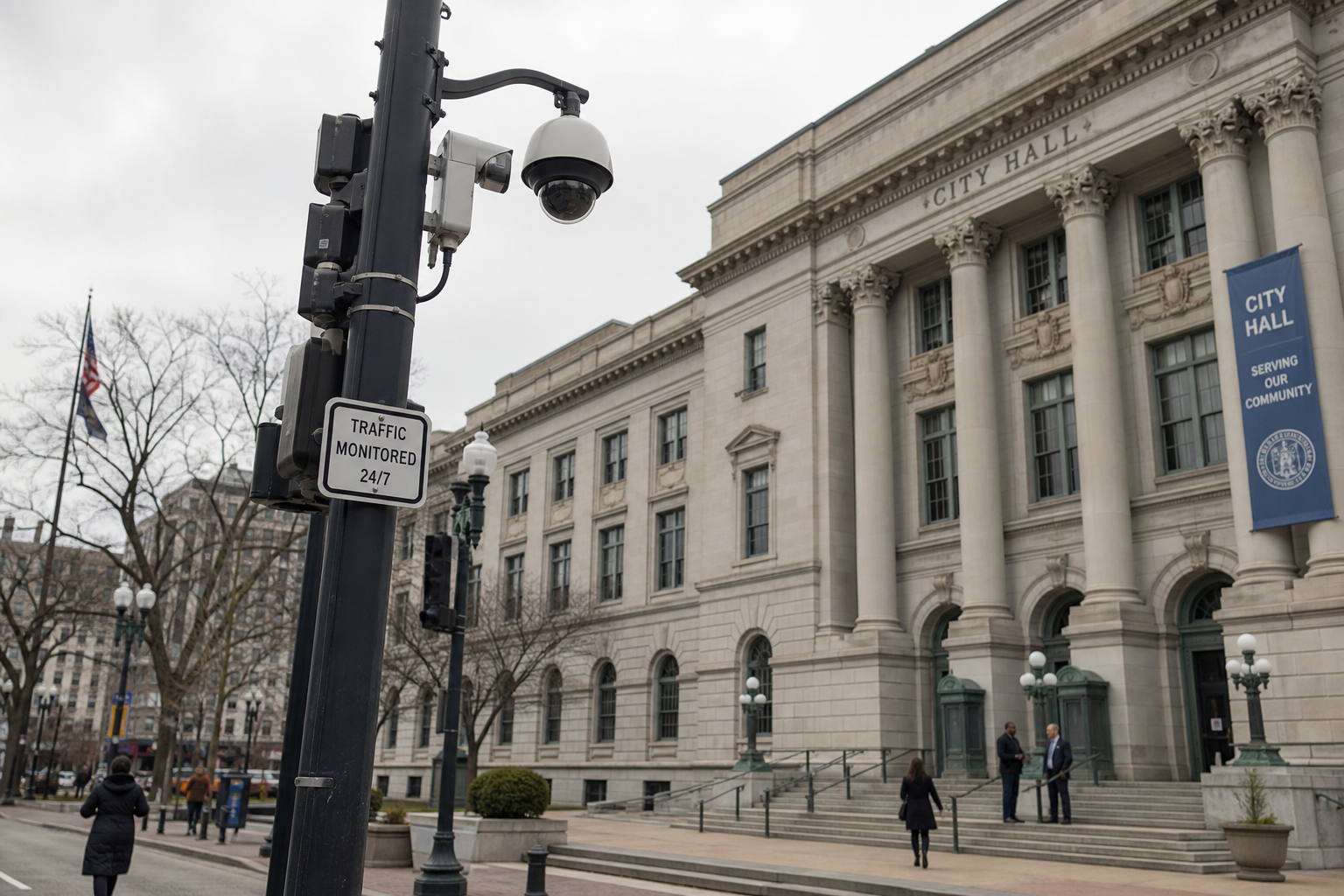
The spread of surveillance is outpacing the rules
American cities are adopting surveillance tools faster than lawmakers are building rules to govern them. Police departments and municipal agencies now have access to a growing menu of technologies: license plate readers, gunshot detection systems, real-time camera networks, drone programs, facial recognition tools, and software that can pull together large amounts of public and commercial data. Some of these tools may help solve crimes or manage emergencies. But the speed of adoption has exposed a basic weakness in our system: the country has no clear, consistent federal framework for how these technologies should be used, audited, or limited.
That gap matters. In a constitutional republic, the question is never simply whether the government can do something more efficiently. It is whether it can do so within durable legal and moral boundaries. Conservatives, in particular, should be wary of granting broad powers to any institution without clear limits. The same government that can monitor for legitimate law-enforcement purposes can also overreach, misuse data, or operate with too little public accountability.
A patchwork approach is not enough
Today, oversight of surveillance technology is fragmented. Some cities have adopted local ordinances requiring public hearings before police acquire new tools. A few states have imposed limits on facial recognition or data retention. Other jurisdictions have few rules at all. The result is a patchwork in which Americans' privacy protections can depend heavily on their ZIP code.
That is not an especially sound way to govern a technology landscape that is national in scope. Many surveillance vendors operate across state lines. Data often moves between agencies, private contractors, and federal databases. A city can purchase software from one state, store information in another, and share records with federal or regional partners. When the technology is integrated, but the rules are not, oversight becomes thin and accountability diffused.
This is one area where a federal baseline makes sense. That need not mean Washington micromanages every police department. It means Congress should set ground rules that protect constitutional liberties while leaving room for legitimate local law-enforcement needs.
Public safety is a real concern, but so is mission creep
Supporters of expanded surveillance are not wrong to point to public safety. Cities face real challenges, including violent crime, organized retail theft, traffic enforcement, and emergency response. In some cases, cameras and automated detection systems can provide useful evidence or improve deployment decisions. It would be unserious to deny that technology can aid policing.
But it would be equally unserious to ignore mission creep. Tools introduced for a narrow purpose rarely stay narrow without firm legal constraints. A license plate reader installed to locate stolen vehicles can become a mechanism for storing the movements of ordinary drivers. A camera network justified by terrorism concerns can be used for broad routine monitoring. A predictive or analytic system marketed as neutral can shape police attention in ways that are hard for the public to evaluate.
The conservative case for regulation begins there. Government power should be bounded, transparent, and answerable to the people. That principle does not disappear because the power is digital.
What a federal framework should include
A serious federal framework would not amount to a national ban on surveillance technology. It would create rules that distinguish between targeted, lawful use and open-ended monitoring of the public. At a minimum, Congress should consider several core protections.
- Clear definitions: Federal law should define categories of surveillance technology so agencies cannot evade oversight by rebranding tools or bundling multiple systems into one purchase.
- Public disclosure: State and local agencies receiving federal funds should disclose what technologies they use, what data they collect, how long they retain it, and with whom they share it, subject to narrow operational exceptions.
- Retention limits: Data should not be stored indefinitely without cause. If a record is not tied to a legitimate investigation, there should be a clear timetable for deletion.
- Warrant standards where appropriate: The more a tool allows persistent tracking or identification of individuals, the stronger the case for judicial approval before use.
- Independent audits: Agencies should be required to conduct regular audits for accuracy, effectiveness, civil-liberties compliance, and disparate error risks, especially for systems that identify or classify people.
- Vendor accountability: Private contractors should not be allowed to hide key details behind trade secrecy when they are selling tools used to exercise public power.
- Private right of action or meaningful remedies: Rules without enforcement tend to become suggestions. Citizens need some avenue for redress when government misuse causes real harm.
None of this is radical. It is basic constitutional housekeeping for a digital age.
Facial recognition deserves special caution
If one category of surveillance merits especially close scrutiny, it is facial recognition. The technology has improved over time, but it remains controversial for good reason. It raises distinct concerns about misidentification, mass tracking, and the practical erosion of anonymity in public spaces. Once governments can identify large numbers of people automatically through camera feeds, the character of public life changes.
Americans have long accepted that being in public does not guarantee total privacy. But there is a meaningful difference between being seen by passersby and being cataloged, matched, and stored by the state at scale. That difference is not merely technical. It goes to the heart of the balance between liberty and order.
A prudent federal framework would impose strict limits on facial recognition, especially for real-time use in public spaces. At the very least, lawmakers should require heightened standards, detailed reporting, and narrow permissible uses tied to serious crimes or immediate threats.
Federalism and local control still matter
Some conservatives will understandably hesitate at the phrase federal regulatory framework. In many areas, that instinct is healthy. Washington often regulates with a heavy hand and leaves local officials to sort through the damage. But a federal baseline here is consistent with federalism properly understood.
Federalism does not mean every city should improvise its own civil-liberties regime while technology companies and data brokers operate on a national market. It means different levels of government have different competencies. Congress is well positioned to establish minimum rights protections and conditions on federal funding, while states and cities remain free to adopt stricter safeguards if they wish.
That approach would preserve local flexibility without treating constitutional concerns as optional.
Trust in institutions depends on visible restraint
There is also a broader institutional point. Public trust in government is already weak. Citizens are more likely to accept legitimate law-enforcement tools when the rules are visible, stable, and enforced. The worst path forward is the current one: quiet deployment, vague policies, contractor opacity, and after-the-fact discovery that a system was broader than advertised.
Restraint is not anti-police. On the contrary, sound guardrails protect law enforcement from the temptation to rely on tools that may be legally vulnerable, publicly mistrusted, or operationally oversold. Clear rules benefit honest officers and agencies as much as they benefit the public.
The constitutional test
The real question is simple. Will the United States govern surveillance technology before it becomes a normalized form of administrative power, or only after abuses make reform unavoidable? Our history suggests that institutions often prefer the latter course. But prudence counsels otherwise.
Conservatives should not surrender this issue to civil-liberties groups on the left. Skepticism of concentrated power is part of the American constitutional tradition. A government capable of watching everyone, all the time, is not made safer merely because its intentions are said to be good. Free societies require more than good intentions. They require rules, limits, and the discipline to say that not everything technologically possible is politically or morally acceptable.
That is why cities need clearer federal rules now: not to hobble legitimate policing, but to preserve the line between a government that serves the public and one that quietly watches over it without enough restraint.
