
A Measurable Win in the Long Fight Against Opioid Deaths
The latest data on opioid-related deaths offers a rare piece of good news in a public health crisis that has devastated American communities for two decades. After years of rising overdose tolls, preliminary figures indicate that fatal opioid overdoses have declined for the first time in a generation—a modest but real reversal of a catastrophic trend.
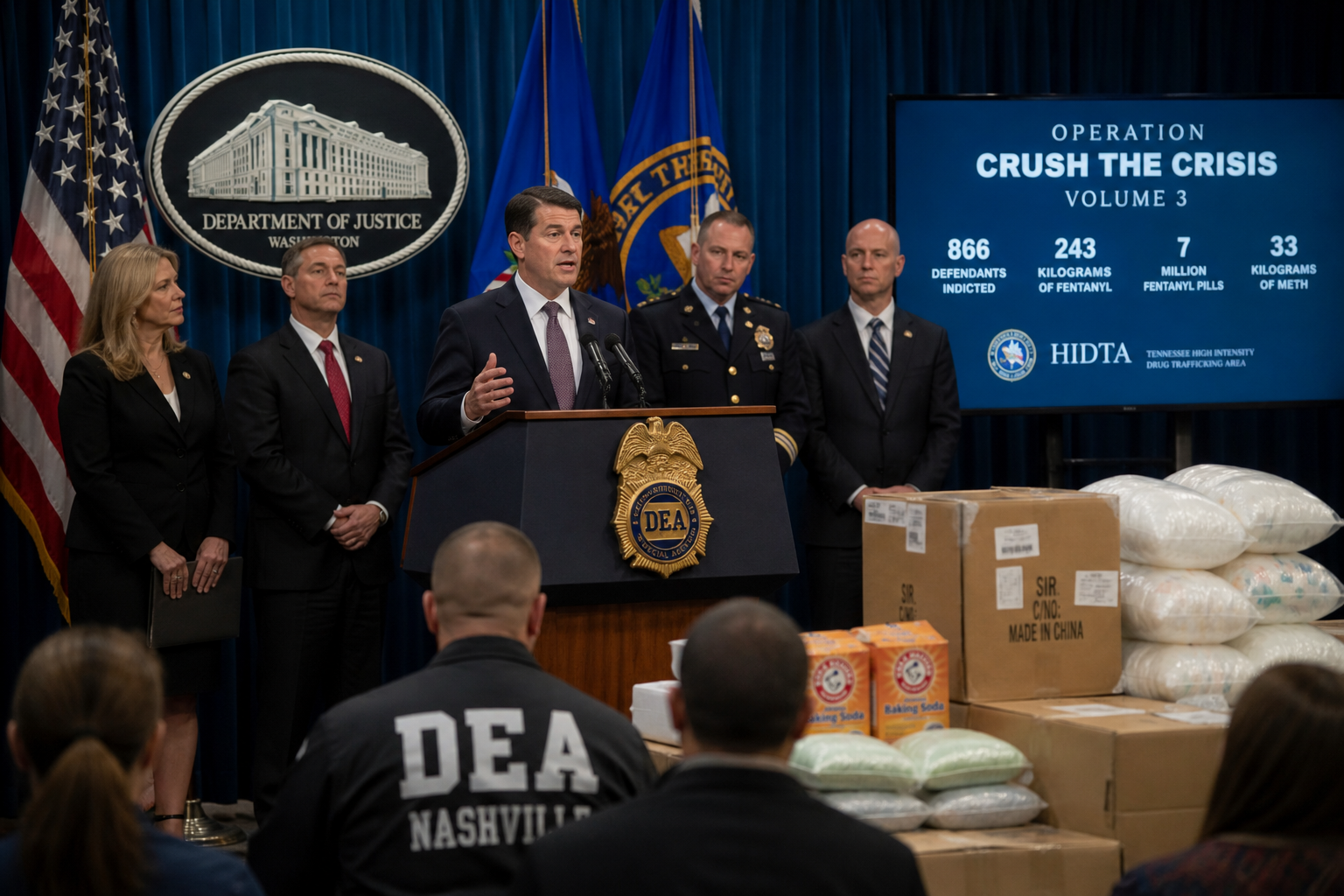
This development deserves careful analysis, not partisan celebration. The decline reflects sustained federal enforcement pressure, particularly targeting illicit fentanyl production and trafficking networks that have flooded American streets with a synthetic opioid far more potent and deadly than heroin. The question for policymakers now is whether this represents a durable shift in the curve, or merely a temporary reprieve.
What Changed: Enforcement and Supply Disruption
Federal law enforcement agencies have escalated interdiction efforts at the southern border and launched coordinated investigations into transnational drug trafficking organizations. These efforts have made it measurably harder—though not impossible—for illicit fentanyl to reach street markets in the volume it did during the peak years of the crisis.
The work is unglamorous and rarely makes headlines, but it is precisely the kind of institutional persistence that conservative governance emphasizes. Federal agents working in cooperation with state and local partners have pursued supply-side strategies: disrupting production, interrupting distribution networks, and holding accountable the criminal enterprises profiting from addiction.
At the same time, medication-assisted treatment and overdose-reversal medications like naloxone have become more widely available and less stigmatized. This represents a pragmatic alliance between treatment providers, public health officials, and law enforcement—an acknowledgment that reducing opioid deaths requires both enforcement and compassion, not either-or thinking.
Why Measurement Matters
Before celebrating too enthusiastically, it is worth noting that preliminary data can shift as final figures are collected. The decline, while real, remains modest compared to the scale of the crisis at its peak. Tens of thousands of Americans still die annually from opioid-related causes, and the suffering extends far beyond mortality statistics to include addiction, family disruption, and community erosion.
Moreover, the opioid crisis is not monolithic. Different regions face different challenges. Rural communities ravaged by prescription opioid addiction face distinct obstacles compared to urban centers where illicit fentanyl dominates. Any national policy must account for these variations rather than imposing uniform solutions.
The Institutional Conservative Case
From a conservative policy perspective, this moment offers clarity on several principles that should guide opioid strategy going forward.
First, institutional competence matters. The federal government's core responsibility includes border security and enforcement of drug laws. When these institutions work—when enforcement agencies receive adequate resources and clear direction—results can follow. This vindication of traditional law-and-order approaches should not be dismissed as mere ideology; it is observable fact.
Second, federalism works. State and local law enforcement, working with federal agencies, have local knowledge and community ties that centralized bureaucracies lack. The most effective enforcement operations combine resources and coordination from all levels. The temptation to consolidate all drug policy in Washington should be resisted in favor of supporting partnerships that respect state and local authority.
Third, treatment and enforcement are not opposites. A sound policy recognizes that addiction is simultaneously a criminal matter (when it involves trafficking and distribution) and a medical matter (when it involves individuals struggling with dependency). Neither approach alone suffices; both are necessary.
What Still Needs Doing
The decline in opioid deaths, if sustained, represents progress on one metric. But the deeper work of addressing addiction's root causes remains undone. The opioid crisis emerged partly because of over-prescription of pharmaceutical pain medications, a failure of both industry oversight and medical practice. Repairing trust in pain management and in medical institutions more broadly requires accountability and transparency.
Prevention and education, particularly for young people, deserve sustained investment. The lesson of the opioid crisis is that supply-side interventions alone cannot solve demand-side problems. A generation of young Americans witnessed the devastation wrought by opioid addiction; that knowledge can be a protective factor if it is channeled into honest conversation about risk and consequence.
Finally, the communities hit hardest by the opioid crisis—economically struggling rural areas, low-income urban neighborhoods—need more than drug enforcement. They need economic opportunity, stable employment, functional institutions, and genuine hope. These are not problems federal enforcement can solve. They require longer-term investment in community resilience, education, and economic development.
Looking Ahead
The decline in opioid deaths should be celebrated for what it is: evidence that sustained, competent federal action addressing a genuine public health emergency can produce measurable results. It is a reminder that institutions, when they function properly and receive adequate resources, can serve the public good.
But it should also be sobering. The crisis is not over. The work of reducing overdose deaths, treating addiction, and rebuilding communities ravaged by opioid abuse will require sustained commitment across multiple policy domains. That is the unglamorous reality of governing: the real victories come not from dramatic gestures, but from the daily, persistent work of institutions doing what they were designed to do.
