
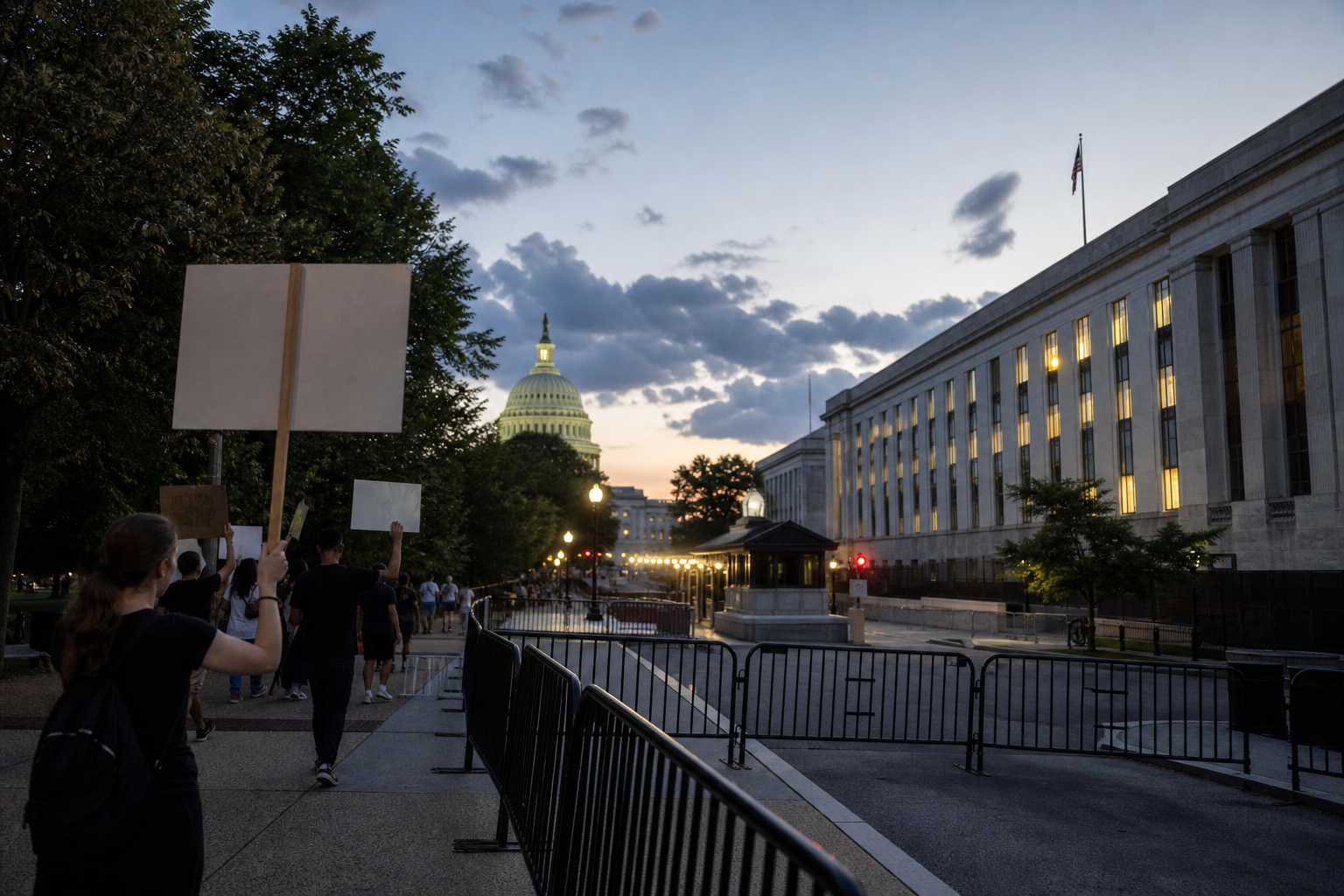
There is a familiar pattern in American political life: whenever federal investigators or congressional committees begin asking unwelcome questions about foreign ties, the loudest objection is often not to the facts being examined, but to the very act of examination itself. The cry goes up that this is persecution, that dissent is under attack, that dark ghosts from the 1950s are back in the room.
That argument deserves more skepticism than it usually gets.
Groups on the far left, including organizations such as CodePink, have every right to protest U.S. foreign policy, criticize defense spending, oppose military aid, and organize in public. In a free society, those rights are not a concession from the state; they are a constitutional guarantee. But it does not follow that activists, because they use the language of peace or social justice, should be insulated from legitimate scrutiny when questions arise about foreign influence, undisclosed coordination, or possible violations of laws governing lobbying, sanctions, or financial disclosure.
Free Speech and National Security Are Not Opposites
One of the more damaging habits of modern political rhetoric is the assumption that any government inquiry touching on activism must be an assault on civil liberties. That is too simple, and it confuses two separate questions.
The first question is whether Americans may advocate unpopular views. The answer is plainly yes. The second is whether the government may investigate credible concerns involving foreign governments, foreign nationals, sanctions evasion, or unregistered influence operations. The answer to that question is also yes.
Those principles are not in tension unless the government uses investigative power as a pretext to punish speech itself. That is a real danger, and conservatives of all people should take it seriously. We have seen federal power abused before, against groups across the political spectrum. But the possibility of abuse does not mean every inquiry is abusive. A constitutional system requires oversight precisely because foreign states do attempt to shape American debate through sympathetic intermediaries, advocacy networks, media campaigns, and informal political relationships.
That is not paranoia. It is basic statecraft.
The McCarthy Label Is Too Often a Shield
The word “McCarthyism” still carries moral force, and for understandable reasons. It refers not merely to anti-communism, but to reckless accusation, guilt by association, and the substitution of insinuation for evidence. It is a useful warning from history. What it is not is a magic phrase that ends inquiry.
Too often, activists invoke the term not when they are denied due process, but when they are asked to answer ordinary questions: Who funds this work? What contacts exist with foreign entities? Are advocacy efforts being coordinated with outside interests? Have legal disclosure requirements been met? Has anyone crossed the line from protest into material support, unlawful lobbying, or sanctions-related conduct?
Those are not sinister questions. They are the sort of questions any serious government should ask when national security or foreign influence is at issue.
Indeed, the irony here is that many of the same political factions that demand aggressive investigations into domestic extremism, election interference, and foreign disinformation suddenly discover a sweeping libertarianism when scrutiny falls on their own ideological allies. That inconsistency is hard to miss. If one believes foreign influence is a serious problem in American public life, one does not get to care only when the suspected influence runs in a politically convenient direction.
Activism Does Not Confer Immunity
There is a broader cultural temptation, especially on the left, to treat activism as a kind of moral credential that exempts its practitioners from ordinary standards of accountability. The assumption seems to be that because a cause is described as anti-war or anti-imperialist, the people advancing it must therefore be presumed pure in motive and above suspicion.
But motives are not self-certifying, and causes do not erase legal obligations.
An organization may sincerely oppose U.S. foreign policy and still become entangled, knowingly or not, in the interests of foreign actors. A protest movement may present itself as grassroots while relying on networks that deserve scrutiny. None of this makes dissent illegitimate. It simply means the republic has an interest in transparency.
That should not be controversial. We already accept the principle in other contexts. Nonprofits face reporting requirements. Campaigns must disclose donors. Lobbyists must register. Financial institutions are expected to watch for unlawful flows of money. The same society that demands transparency from businesses and candidates can reasonably expect it from political organizations operating in areas where foreign influence is a live concern.
Congress and Investigators Have a Duty to Ask Questions
Congressional oversight is often messy, theatrical, and imperfect. Federal investigations can also be overbroad. But the answer to those institutional flaws is better oversight and stricter adherence to legal standards, not a blanket rule that politically active groups are beyond examination.
In fact, Congress has a clear responsibility to understand how foreign governments and aligned networks attempt to shape domestic debate. That duty extends beyond espionage in the narrow sense. Modern influence campaigns are often softer and more ambiguous. They move through funding channels, advocacy partnerships, digital amplification, think tank ecosystems, and issue campaigns designed to pressure elected officials.
Some of that activity is legal. Some may not be. The point of investigation is to determine which is which.
Conservatives should be especially clear on this point. A serious right does not argue for an all-powerful security state, but neither does it indulge the fiction that America’s adversaries stop at the water’s edge and play no role in shaping domestic politics. Prudence requires the country to be alert without becoming lawless, skeptical without becoming hysterical, and firm without becoming censorious.
What a Principled Standard Looks Like
A sound public standard would include several basic commitments:
- Protect speech and association: Mere advocacy, even offensive or radical advocacy, is not a crime.
- Demand evidence: Investigations should be tied to facts, not ideological hostility.
- Require transparency: Foreign funding, coordination, and lobbying relationships should be disclosed where the law requires it.
- Apply rules evenly: The same standards should govern left-wing, right-wing, and nonpartisan groups alike.
- Respect due process: Congressional and executive power must be constrained by law, not driven by headlines.
That framework is neither McCarthyite nor permissive. It is simply constitutional government doing what it is supposed to do: balancing liberty with public order, rights with accountability, and openness with national self-protection.
The Republic Needs Seriousness, Not Slogans
The easiest move in politics is to substitute a historical analogy for a substantive defense. It is much simpler to cry “witch hunt” than to answer questions about funding, contacts, disclosure, or coordination. But a mature republic cannot govern itself on slogans alone.
If activists have done nothing improper, a lawful inquiry should establish that. If lines have been crossed, the public has a right to know. Either way, the process of finding out is not itself an outrage.
America’s institutions should never punish citizens for dissent. That principle is nonnegotiable. But those same institutions should not be intimidated into silence whenever an investigation touches people who claim the mantle of protest. Self-government depends on the ability to distinguish between protected speech and potentially unlawful conduct. When that distinction disappears, accountability does too.
Calling every national security investigation “McCarthyism” may be useful politics for the far left. It is not serious constitutional reasoning. And at a moment when foreign influence, ideological polarization, and institutional mistrust all run high, seriousness is exactly what the country requires.
