
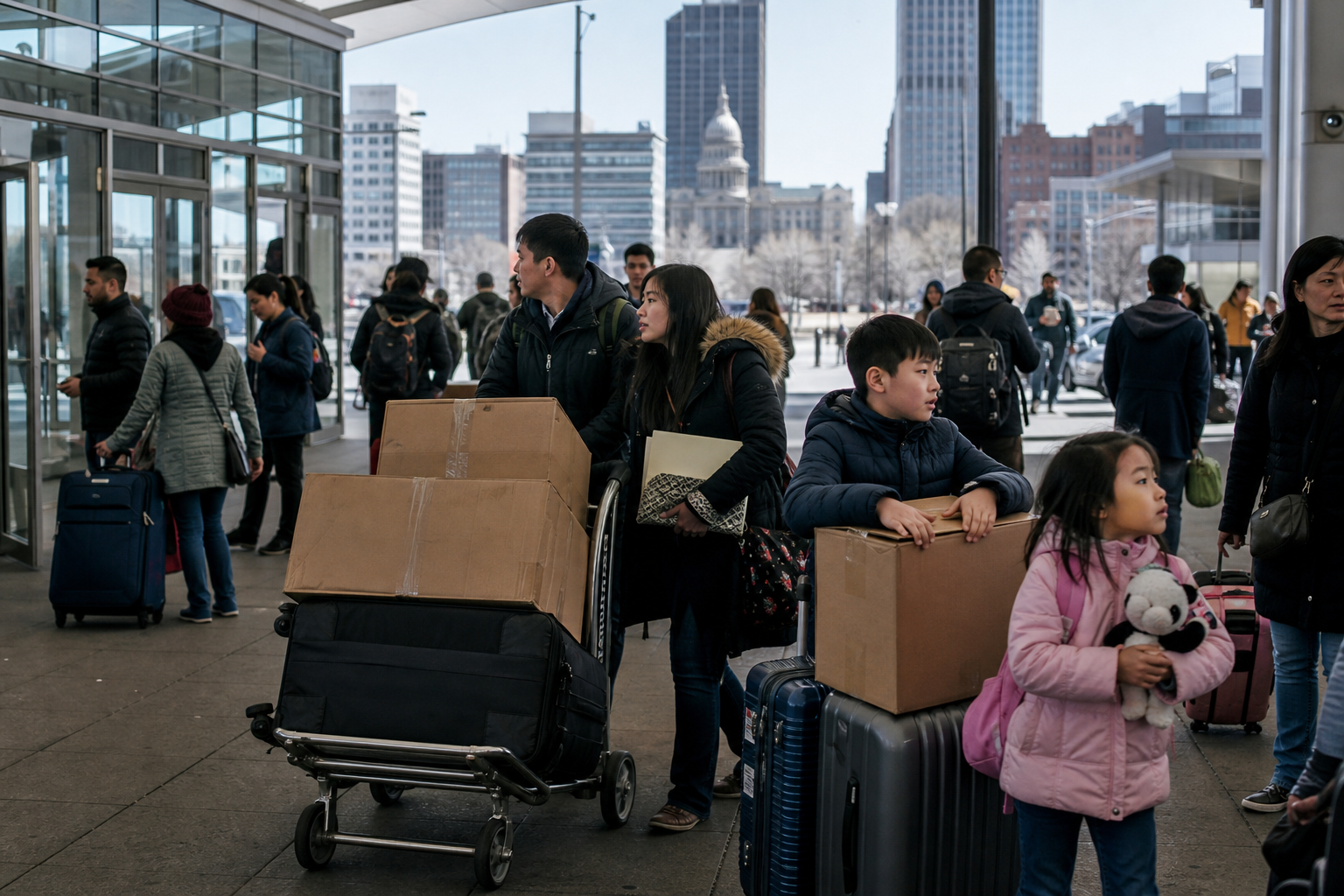
Population loss is not, by itself, a moral verdict on a state. People move for many reasons: family, weather, jobs, retirement, and housing. But when large, high-tax states repeatedly lose residents while lower-tax, lower-cost states gain them, it is no longer enough to dismiss the pattern as coincidence. At some point, public policy has to enter the discussion.
That is where the conservative case against high-tax blue-state governance begins. It is not rooted in contempt for cities or hostility to public services. It rests on a simpler proposition: when state governments make it too expensive to live, work, build, and raise a family, many Americans will leave if they can. And when enough people do that over time, the fiscal and civic consequences become difficult to ignore.
What the Population Numbers Are Telling Us
Recent Census trends have shown a familiar pattern. States such as California, New York, and Illinois have experienced net domestic outmigration, while states such as Florida, Texas, Tennessee, and the Carolinas have often gained residents from elsewhere in the country. The story is not identical in every year, and immigration can offset some domestic losses in certain places. But the broad direction has been clear for years: many Americans are moving away from high-cost states with heavy tax and regulatory burdens toward states that offer more affordable living and stronger job growth.
That does not mean every low-tax state is well governed, or that every high-tax state is failing. It does mean public officials should be careful before assuming people will indefinitely tolerate policies that make ordinary life harder to afford.
The Tax Burden Matters
Progressives often argue that taxes are the price of civilization. In one sense, that is true. Serious government requires revenue, and a modern state has real obligations. The conservative response is not that taxes should be abolished, but that they should be limited, predictable, and tied to competent public stewardship.
In many blue states, residents face a layered burden: high income taxes, high property taxes, high sales taxes in some jurisdictions, and a thicket of fees and compliance costs that may not appear on a tax bill but affect daily life just the same. For upper-income households, those burdens can be substantial. For middle-class families, they can be the difference between staying put and seeking a more manageable life elsewhere.
The argument is not merely ideological. State tax policy affects business decisions, household savings, retirement planning, and housing demand. If a family can sell a smaller home in a coastal metro area and buy a larger one in a Sun Belt suburb while also lowering its tax bill, state policymakers should not be surprised by the outcome.
Housing Costs Are a Policy Choice Too
Taxes are only part of the problem. Housing costs in many blue states are driven upward by zoning restrictions, permitting delays, environmental review regimes, and local political cultures that make new construction exceedingly difficult. Here again, conservatives should resist the temptation to make the argument too narrow. A state can have high taxes and still retain residents if it allows abundant housing and economic dynamism. But where high taxes are combined with artificial housing scarcity, families feel trapped.
This is one of the great policy failures of modern progressive governance. Many Democratic leaders speak in the language of affordability while presiding over systems that make affordability almost impossible. It is not enough to subsidize a fraction of renters if the underlying rules make broad-based homebuilding prohibitively slow and expensive.
That matters politically as well as economically. A society in which middle-income workers cannot reasonably hope to own homes, build equity, and remain near their communities is a society inviting frustration and churn.
Quality of Governance Still Counts
Defenders of high-tax states sometimes respond that residents receive better services in return. Sometimes they do. But voters and taxpayers do not judge government by theory; they judge it by visible performance. If roads are poor, schools underperform, transit systems are unreliable, public disorder goes unchecked, and pension obligations crowd out present needs, then a high-tax model becomes much harder to defend.
This is where conservatives have an opening to make a serious, non-caricatured argument. The issue is not whether government should do anything. It is whether government is doing a few core things well. Public safety, infrastructure, education, and a functional legal environment are not optional extras. They are among the first duties of state and local government.
When those duties are neglected, high taxes begin to look less like an investment and more like a penalty.
The Fiscal Trap of Outmigration
Population decline creates a problem that many state officials are reluctant to confront. When productive workers, business owners, and retirees with means leave, the tax base can erode. The immediate response in some places is to raise taxes further on those who remain. But that can deepen the problem rather than solve it.
There is a compounding effect here. Fewer residents can mean weaker housing demand in some areas, slower business formation, and greater difficulty funding long-term obligations. Meanwhile, fixed costs remain. Governments still have debt to service, public payrolls to meet, and pension promises to honor. The temptation is to squeeze more from a shrinking or more economically constrained base.
That is not a sustainable model. A state cannot tax its way back to competitiveness if the tax structure itself is helping drive people out.
A Conservative Alternative
The conservative case, properly understood, is not anti-city and not anti-government. It is pro-growth, pro-family, and pro-competence. It asks whether states are creating the conditions in which ordinary people can live decently without needing elite salaries or public subsidy to remain where they are.
A better path would include:
- Lower and flatter tax burdens that do not punish work, investment, and retirement.
- Serious housing reform to allow more building and reduce artificial scarcity.
- Regulatory restraint so businesses and builders can operate without endless delay.
- Reliable public safety and enforcement of basic civic order.
- Fiscal discipline that addresses pension liabilities and spending growth before they become unmanageable.
None of this guarantees instant population growth. But it would signal that state governments understand the basic bargain of citizenship: taxpayers are entitled not simply to programs, but to a livable commonwealth.
Why This Debate Matters Beyond One Party
There is a tendency in national politics to treat interstate migration as a kind of partisan scoreboard. That is too shallow. The deeper question is whether American states can still govern in ways that keep broad middle-class life within reach. If some of the nation's wealthiest and most celebrated states are steadily becoming harder for ordinary families to afford, then the problem is not merely electoral. It is civic.
Conservatives should make this case with some humility. Prosperity is never the product of tax policy alone, and no state model is beyond criticism. But the broad lesson is hard to miss. When government grows costly, cumbersome, and inattentive to the practical burdens of family life, people will eventually look for an exit.
That is not a mystery of demographics. It is a consequence of policy. And until blue-state leaders reckon with that reality, the population decline many now lament will remain less a surprise than a predictable result.
