
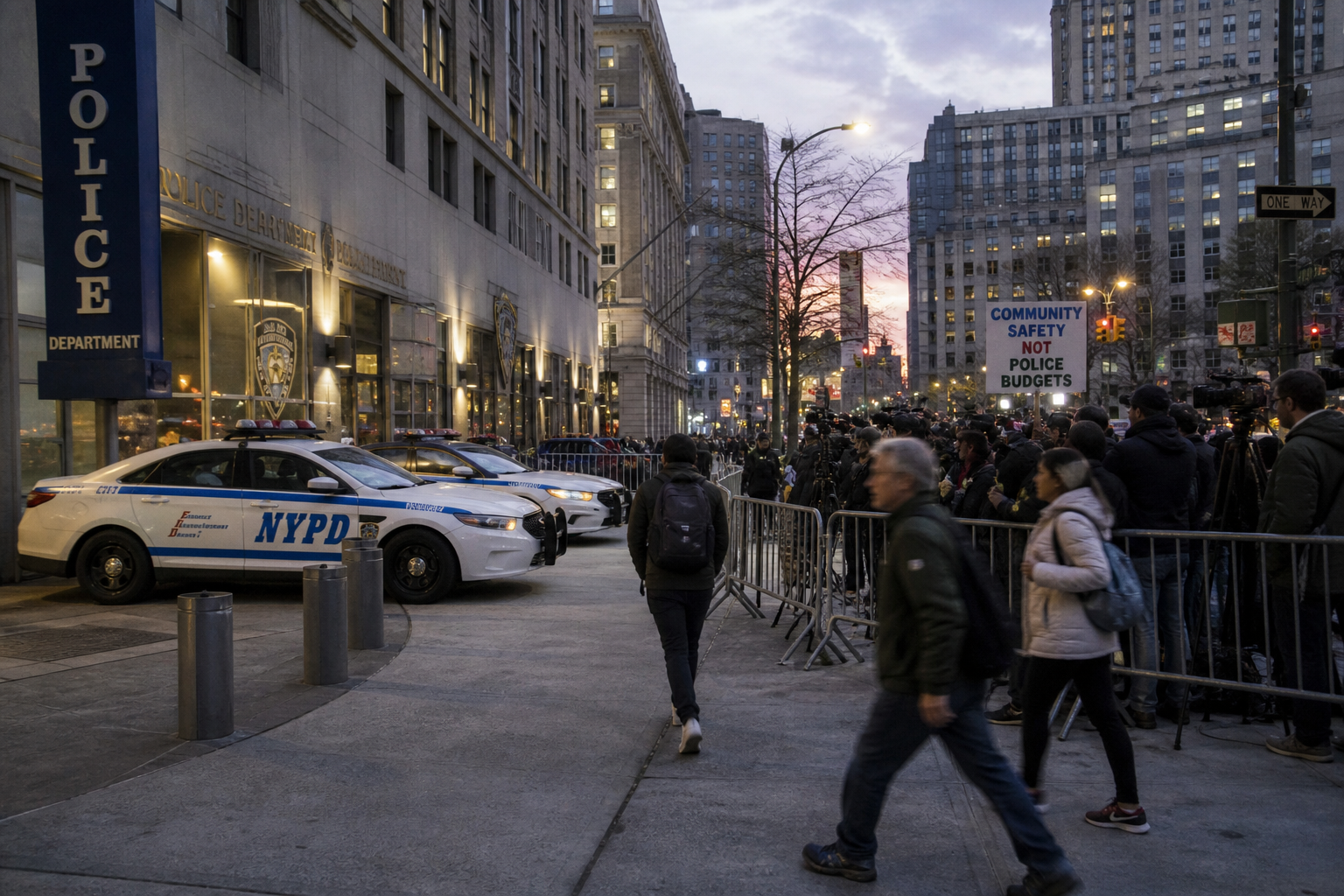
Rep. Alexandria Ocasio-Cortez has spent years associated, fairly or not, with the slogan defund the police. That phrase became one of the most politically damaging messages of the post-2020 era, especially in competitive districts and among voters who may support criminal justice reform but do not want less policing in neighborhoods already struggling with disorder. So when a prominent progressive figure appears to soften or revise that posture, the obvious question follows: is this cynical repositioning, or is it genuine political evolution?
The honest answer is that it may be some of both. And in democratic politics, that distinction matters less than many partisans would like to admit.
Why the phrase became a liability
The problem with defund the police was not merely that Republicans attacked it. It was that the slogan itself was always imprecise, morally loaded, and poorly suited to persuasion. Some activists meant reallocating portions of police budgets toward mental health, housing, or community intervention. Others plainly meant a dramatic reduction in the role of law enforcement. Many ordinary voters heard the phrase in the most literal way possible: fewer officers, slower response times, and weaker public order.
That reaction was not irrational. Public safety is one of the first obligations of government. A constitutional order depends not only on liberty, but on the stable enforcement of law. Citizens cannot exercise freedom meaningfully in neighborhoods where basic order breaks down. Conservatives have long argued, correctly, that the state has a duty to protect the innocent, punish crime justly, and maintain civil peace. Whatever one thinks of police reform, language that suggests retreat from those duties was bound to generate a backlash.
That backlash came quickly. In the years after 2020, Democrats in swing races repeatedly found themselves answering for a slogan many of them did not coin and did not fully support. The issue was not simply messaging discipline; it reflected a deeper divide within the coalition between activists who viewed policing chiefly through the lens of systemic abuse and voters who viewed it through the lens of everyday safety.
What a reversal would actually mean
If Ocasio-Cortez is now moving away from that earlier rhetoric, it would hardly make her unique. Politicians often adjust their positions as the facts change, as public opinion hardens, or as the practical consequences of an idea become clearer. That is not automatically dishonorable. In some cases, it is what prudence looks like.
There is, after all, a legitimate argument for reforming police practices without weakening the institution of policing itself. Better training, clearer use-of-force standards, stronger accountability mechanisms, more professional recruitment, and better coordination with mental health and social services are not anti-police ideas. They are, in many respects, pro-order ideas. They assume that law enforcement is necessary and should be competent, trusted, and constitutional.
If a politician once flirted with a slogan that obscured those distinctions and now speaks more carefully, that may indicate learning. Public officials are not required to remain frozen in their worst or least precise formulations forever.
The case for skepticism
Still, voters are entitled to be skeptical. A change in rhetoric is not the same thing as a change in judgment. If the new language emerges only when the old language has become politically radioactive, cynicism is a reasonable inference. Americans have seen this pattern before: an activist slogan gains momentum in elite circles, proves unpopular beyond them, and then is retroactively redefined as something more moderate than it ever sounded at the time.
That pattern erodes trust because it asks the public to pretend not to remember what was said plainly in the moment. Political accountability requires more candor than that. If a public figure has changed her mind, the credible way to show it is simple: say so directly. Explain what was wrong with the earlier framing, what experience prompted reconsideration, and what policy approach now seems better grounded in reality.
That kind of admission is rare in politics because it carries short-term costs. But in the long run, it serves democratic trust better than semantic evasions.
What this says about the Democratic Party
The larger significance here goes beyond one member of Congress. The Democratic Party has spent much of the past several years struggling to reconcile progressive activist language with the instincts of working- and middle-class voters, including many minority voters, who tend to be more moderate on questions of crime and disorder than progressive elites assume.
This is not hard to understand. Affluent neighborhoods can romanticize experiments in reduced enforcement because they are often insulated from the consequences. Working-class neighborhoods usually are not. When shoplifting rises, when public transit feels less safe, when response times lengthen, or when disorder becomes normalized, the burden falls most heavily on people with the fewest alternatives.
That is one reason the center of gravity in policing debates has shifted. Even many reform-minded voters have come to see that public order and civil liberties are not enemies. They are obligations to be balanced. A government that cannot keep streets safe will eventually lose public confidence, and a police force that abuses its authority will lose legitimacy. The answer is not abolitionist rhetoric. It is competent reform inside durable institutions.
A conservative lesson on reform and order
Conservatives should resist the temptation to treat every progressive revision as inherently fraudulent. Sometimes people do learn. Sometimes events discredit abstractions. Sometimes governing realities expose the weakness of movement slogans. If that is happening here, it should be welcomed, not merely mocked.
But conservatives should also insist on clarity. Public safety is not a boutique issue. It is a basic function of self-government. Any serious politics of reform must begin from several premises:
- Police are necessary in a free society because laws require enforcement.
- Abuse of police power is real and must be constrained by law, oversight, and professional standards.
- Communities need order and legitimacy together; one cannot be traded away for the other indefinitely.
- Slogans are a poor substitute for policy, especially when they inflame rather than clarify.
Those are not radical propositions. They are the practical foundations of republican government.
Evolution is possible, but accountability still matters
So is this political cynicism or genuine evolution? In all likelihood, it is an adaptation to both political reality and policy reality. That does not make it meaningless. In fact, democratic politics often works precisely this way: bad ideas meet resistance, rhetoric is tested against lived experience, and elected officials move, however reluctantly, toward a more sustainable position.
The public should not demand ideological purity from politicians. It should demand honesty. If Ocasio-Cortez or any other progressive now recognizes that defund the police was a damaging and misguided frame, that is a welcome development. But voters have every right to ask for more than a rebrand. They deserve a clear acknowledgment that public safety is an essential public good, and that reform must strengthen the legitimacy of law enforcement rather than hollow it out.
In the end, the question is not whether a politician can change. The question is whether she can explain that change in a way that respects the public’s intelligence. On policing, as on so much else, Americans are less interested in ideological theater than in competent government. They want safe streets, lawful institutions, and leaders mature enough to tell the truth when experience has corrected them.
